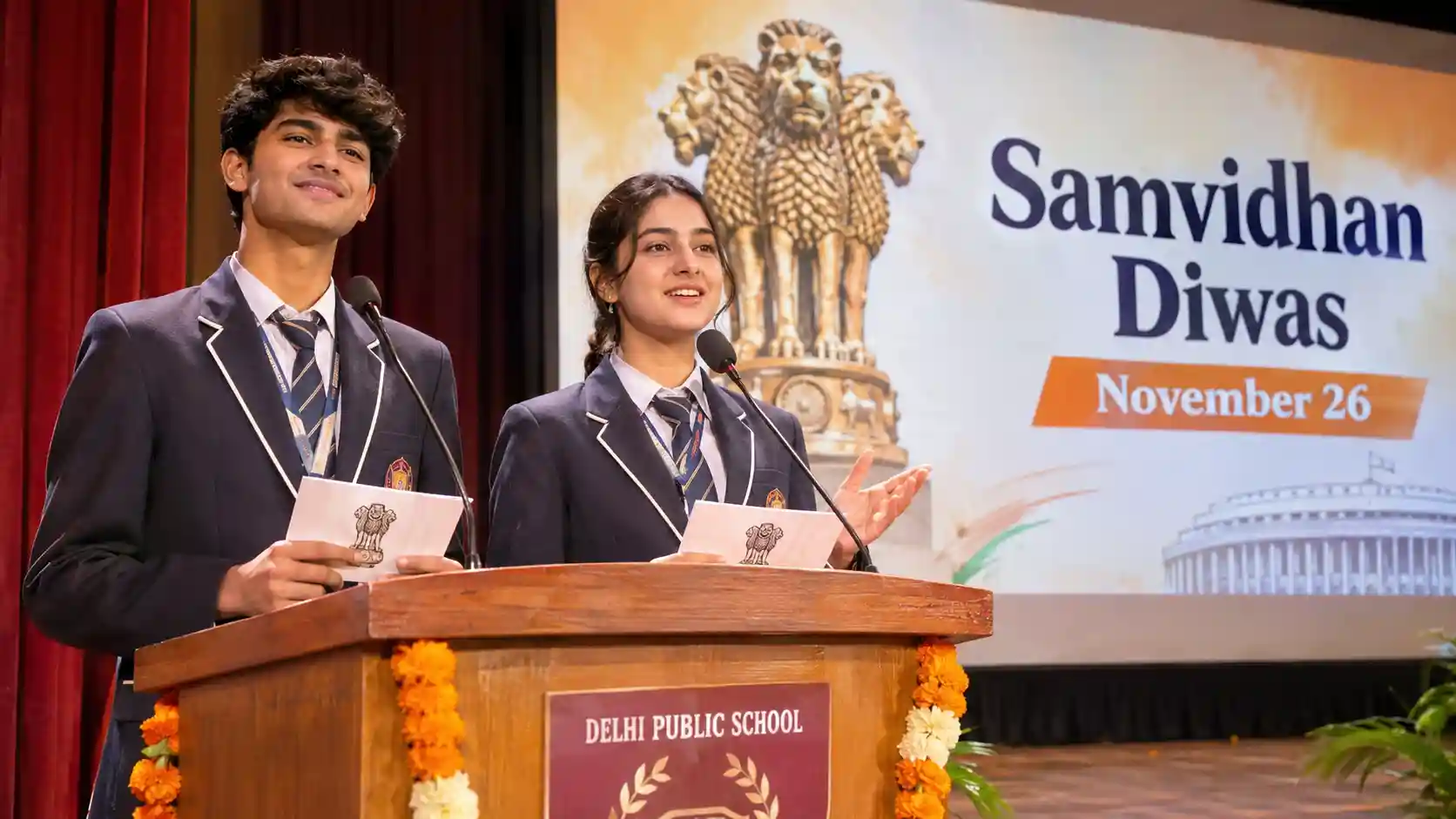
Best Constitution Day Anchoring Script (Nov 26 Assembly)
Why November 26 Demands a Different Style of Stage Hosting
November 26 is one of the few mornings on the Indian school calendar where an anchor cannot rely on festival excitement or loud music to carry the room.
Unlike a Cultural Fest where the crowd is already buzzing, or Republic Day where a full parade sets the mood outdoors, Constitution Day (Samvidhan Diwas) usually takes place during a standard morning slot right before first-period classes begin.
Students stand in rows thinking about their upcoming tests, and if the hosts walk up to the podium and start reading a dry history chapter full of dates and article numbers, the entire hall tunes out in thirty seconds.
What makes a Constitution Day assembly actually work is turning a history lesson into a living story. On November 26, 1949, the Constituent Assembly completed the monumental task of drafting the world’s longest written constitution after nearly three years of intense debate.
When you step up to the microphone, your job isn’t to lecture your classmates like a civics textbook—it is to make them feel the weight of that achievement and prepare them to take the collective oath with genuine pride.
Below is a complete, stage-tested guide and dual-anchor script written in a natural English and Hindi blend, complete with backstage checks, crowd-pacing cues, and troubleshooting advice so your assembly runs smoothly from the first bell to dispersal.
Common Mistakes Anchors Make on Constitution Day
Before you print your cue cards, watch out for these four specific traps that trip up student hosts every November:
- Turning the introduction into a Republic Day speech: Many students confuse the historical timeline and accidentally tell the audience that the Constitution came into full force on November 26. Make sure your script clearly distinguishes that November 26, 1949, is the day the document was adopted, while January 26, 1950, is when it came into effect. Getting that basic fact wrong in front of the history faculty immediately undercuts your credibility.
- Rushing the mass oath reading: When five hundred students repeat an oath in a large hall or open ground, sound travels slowly from the back rows to the stage. Novice anchors read the next phrase before the junior classes have finished repeating the previous one, turning the pledge into a mumbled echo. You must leave a deliberate three-second silence after every single clause.
- Stumbling over formal Hindi and Sanskritized terms: If your co-anchor is delivering lines in Hindi, words like Samvidhan, Prastavana, Sampoorna Prabhutva-Sampanna, and Bandhutva require crisp pronunciation. Reading them cold off a sheet of paper almost always causes a tongue-slip on the microphone. Practising the proper technique for anchoring—especially slowing down your tempo by twenty percent on heavy vocabulary—keeps your delivery sharp.
- Forgetting to instruct the audience on posture before the pledge: Nothing looks messier than half the students raising their right hands while the other half stand with their arms folded because the anchor forgot to give a clear command before starting the reading. Always give a crisp, two-step physical instruction before speaking the first word of the oath.
Complete Constitution Day Anchoring Script (Anchor 1 & Anchor 2)
Note for Anchors: To help you practice the natural timing and stage rhythm, we have used realistic sample names in bold (such as St. Xavier’s High School, Dr. S.K. Verma, Rohan, and Class 9th B) throughout the script below. Simply swap the bolded names with your own school, Principal, and student names before your rehearsal!
Segment 1: The Opening Hook & Historical Context
(Both anchors walk to the center podium at a steady, composed pace. Wait two seconds for the morning assembly lines to settle into silence before speaking.)
Anchor 1: Seventy-seven Novembers ago, inside the Central Hall of Parliament in New Delhi, two hundred and ninety-nine men and women picked up their pens and signed their names to a handwritten promise.
That promise took two years, eleven months, and eighteen days to debate—and it became the backbone of modern India. A very good morning to our Respected Principal, Dr. S.K. Verma, our dedicated faculty members, and my fellow students of St. Xavier’s High School.
Anchor 2: Sabhi ko suprabhat! Aaj 26 November hai—ek aisa din jise har Bhartiya nagrik bade garv ke saath Samvidhan Diwas yaani Constitution Day ke roop mein manata hai.
Hum aksar sochte hain ki Samvidhan sirf kanoon ki ek badi si kitaab hai jo courts aur parliament mein kaam aati hai.
Lekin sach toh yeh hai ki aaj hum jis azaadi se is school mein padh rahe hain, apni baat rakh rahe hain, aur bade sapne dekh rahe hain—woh sab isi mahaan granth ki den hai.
Anchor 1: Well said, Ananya. Before 2015, this date was observed across the country as National Law Day.
To mark the 125th birth anniversary year of Dr. Bhimrao Ramji Ambedkar—the Chairman of the Drafting Committee – the Government of India officially declared November 26 as Constitution Day so that every student and citizen understands the values that hold our diverse nation together.
Segment 2: Introducing the Student Address on Dr. B.R. Ambedkar & the Makers
Anchor 2: Doston, kya aap jaante hain ki hamara original Samvidhan kisi printing press mein type nahi kiya gaya tha?
Use Prem Behari Narain Raizada ji ne apne haathon se behad khoobsurat italic calligraphy mein likha tha, aur Shantiniketan ke kalakaron ne uske har panne ko Bhartiya itihaas ki tasveeron se sajaya tha.
Anchor 1: You can still explore those original illuminated pages and the Constituent Assembly Debates and historical archives online today. Behind those artistic pages were fierce, brilliant minds who debated every single comma and clause to ensure that every citizen—regardless of language, faith, or background—received equal rights.
Anchor 2: Usi itihaas aur Dr. B.R. Ambedkar ji ke yogdaan par roshni daalne ke liye, main manch par aamantrit karti hoon Class 10th A ke chhatra Aarav Sharma ko. Aaiye, taaliyon ke saath unka utsah badhayein.
(Anchors step back to the side of the podium while the student delivers a 3-minute speech. As the speaker finishes and bows, Anchor 1 steps back to the mic immediately.)
Segment 3: Fundamental Duties vs. Fundamental Rights (Interactive Transition)
Anchor 1: Thank you, Aarav, for reminding us of the tireless effort it took to build our democratic framework. Everyone in this hall knows that our Constitution gives us Fundamental Rights—the right to equality, the right to freedom of speech, and the right to education.
Anchor 2: Bilkul, Rohan! Hum apne adhikaar yaani Rights toh hamesha yaad rakhte hain, par Samvidhan ka Article 51A humein hamare Fundamental Duties—yaani Maulik Kartavyon—ki bhi yaad dilata hai. Apne school campus ko saaf rakhna, rashtriya pratikon ka samman karna, aur ek doosre ke prati bhaichara rakhna hi ek sachche student ki pehchaan hai.
Anchor 1: To bring those everyday civic duties to life, the students of Class 9th B have prepared a short, five-minute thematic presentation on “Rights Walk Hand-in-Hand with Responsibilities.” Let us welcome them to the stage with a warm round of applause.
(Pause for the short presentation or skit. Once the students exit the stage, both anchors return to the center microphone.)
Segment 4: Leading the Mass Reading of the Preamble (The Main Event)
Anchor 1: That presentation by Class 9th B hit the nail on the head—a constitution only stays alive through the actions of its citizens. We now arrive at the most solemn and important part of our morning assembly: the collective reading of the Preamble to the Constitution of India.
Anchor 2: Samvidhan ki Prastavana sirf kuch shabd nahi hain, balki poore Samvidhan ki aatma hai. Main sabhi teachers aur students se vinamra nivedan karti hoon ki woh apni jagah par seedhe savdhan ki mudra mein khade ho jayein.
Anchor 1: To lead the entire school in the official reading of the Preamble, I humbly invite our Respected Principal, Dr. S.K. Verma, to the center podium. Students, on the Principal’s cue, please raise your right hand forward at shoulder height and repeat each phrase clearly and with full dignity. Sir, please.
(The Principal steps up to lead the Preamble reading. If the student anchors are assigned to lead it directly, Anchor 1 reads each short phrase of the official Preamble slowly, pausing three full seconds between lines so the student body can repeat in unison.)
Anchor 2: (Speaking calmly once everyone lowers their hands) Thank you, Sir, and thank you to every student for making that collective pledge echo across our campus with such pride and discipline.
Segment 5: Principal’s Remarks & Assembly Dispersal
Anchor 1: Before we conclude this special observance, I request our Principal, Dr. S.K. Verma, to remain at the podium for a few moments and share his thoughts with us on this Constitution Day.
(Pause for the Principal’s brief address.)
Anchor 2: Bahut-bahut dhanyawad, Sir. Aapki baatein humein hamesha ek zimmedar nagrik banne ki prerna deti hain. Hum apne Social Science department ke teachers aur backstage sound team ka bhi aabhar vyakt karte hain jinhone aaj ki is special assembly ko safal banaya.
Anchor 1: Carry the spirit of justice, liberty, and equality into your classrooms today. Assembly, please stand at attention for the National Anthem, after which classes will disperse row by row. Have a purposeful day ahead!
What to Do If Something Goes Wrong Onstage
Morning assemblies on November 26 have a few unique pressure points. Use this quick recovery table if you hit a snag live on the microphone:
| Stage Situation | What the Anchor Should Do & Say |
| The printed Preamble card blows away or goes missing | Keep a second backup copy taped flat onto the wooden surface of the podium before the bell rings. Never hold a loose single sheet of paper outdoors in November wind. |
| Students in the back rows fall out of sync during the oath | Slow down immediately and shorten the chunks you read aloud. Instead of reading a ten-word line, read three to four words at a time and use your left hand subtly to signal when the crowd should speak. |
| The Principal asks the anchors to lead the oath at the last minute | Stay calm and step forward together. Anchor 1 should give the posture command (“Raise your right hand”) and read the phrases in a loud, steady voice, while Anchor 2 repeats into the second mic along with the students to guide the crowd’s timing. |
| Outdoor microphone cuts out mid-assembly | Project from your diaphragm toward the middle row of students rather than shouting from your throat, and signal the student standing nearest the amplifier desk to check the receiver cable. |
Director’s Notes: Mastering the Tone of Samvidhan Diwas
Hosting a constitutional observance requires a very specific vocal register that sits right between a solemn remembrance day and a celebratory national holiday.
Unlike Martyrs’ Day, where your voice should be hushed and somber, Constitution Day is a proud celebration of Indian democracy—yet it still demands intellectual gravitas. Avoid the casual, high-pitched banter you would use at a farewell party or a sports meet.
Instead, stand with your weight balanced evenly on both feet, keep your shoulders squared, and drop your speaking pitch slightly so your voice carries authority across the assembly ground.
Pay special attention to how you and your co-anchor handle the transition into the Preamble reading. The shift from the student presentation to the oath needs a visible change in physical energy.
Before you invite the Principal or ask the students to raise their hands, pause for two full beats of silence. That brief quiet signals to five hundred students that the casual portion of the morning is over and a formal national pledge is about to begin.
Finally, rehearse the pacing of the oath at least three times with a stopwatch the afternoon before the assembly. Most student anchors read formal constitutional words far too fast because their adrenaline is spiking.
Force yourself to tap your index finger twice against the side of the podium after the audience finishes each phrase before you speak the next line. That disciplined rhythm is what turns a routine morning reading into a goosebump-inducing moment the entire school remembers.