World Water Day Anchoring Script 2026: Save Water Assembly (March 22)
“Thousands have lived without love, but not one without water.”
Every year on March 22, the United Nations observes World Water Day to highlight the importance of fresh water and advocate for the sustainable management of freshwater resources.
For schools and educational institutions, this is a crucial day for raising environmental awareness. Most schools organize a special morning assembly featuring speeches, skits, and the most important element: the Water Pledge (Jal Shapath).
If you are the anchor for this event, your job is to make students realize that saving water is not just a chapter in their science textbook—it is a real-world emergency. The tone of the assembly should be educational, inspiring, and slightly urgent.
Below is a complete, dual-language (English and Hindi) World Water Day Anchoring Script designed specifically for school assemblies. It includes the exact words you need to host the event flawlessly.
The Script: World Water Day Assembly (March 22)
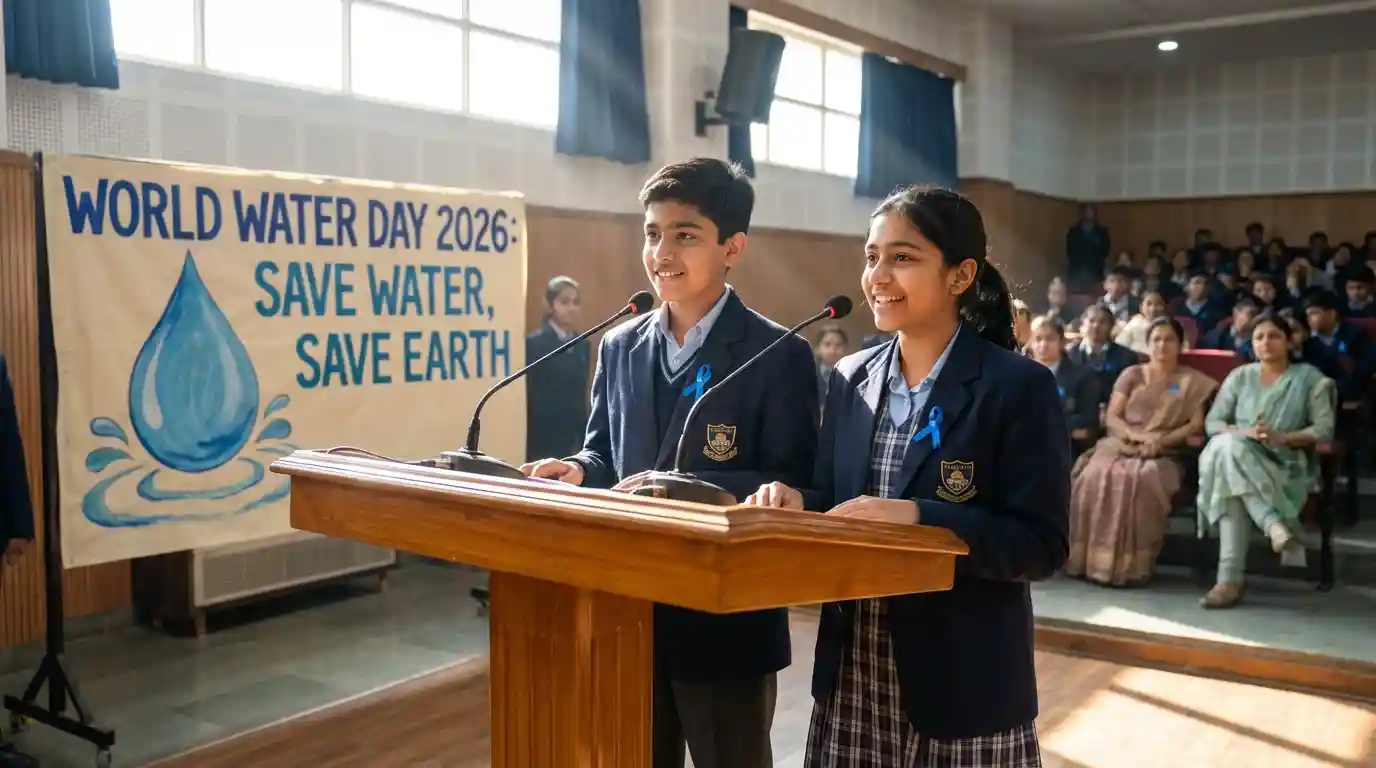
(Scene: Both anchors walk to the podium. The stage is decorated with blue charts and water-drop cutouts.)
Part 1: The Introduction (Bhumika)
Anchor 1: “Good morning to the Respected Principal, teachers, and my dear friends. Today, we are celebrating a day dedicated to the very essence of life on Earth.”
Anchor 2: “Aap sabhi ko Suprabhat! Aaj 22 March hai, yani Vishva Jal Diwas (World Water Day). Aaj hum yahan us cheez ka samman karne aaye hain jiske bina jeevan ki kalpana bhi nahi ki ja sakti—Paani.”
Anchor 1: “It is rightly said that if there is magic on this planet, it is contained in water. Without it, our blue planet would just be a barren rock.”
Anchor 2 (With emphasis): “Jal hi jeevan hai, yeh na ho toh sab veerana hai,
Boond-boond ko bachana hai, hum sabne yeh thaana hai!”
Part 2: Welcoming the Principal / Guest Speech
Anchor 1: “To shed more light on the global water crisis and how we, as students, can make a difference, I would like to invite our Hon’ble Principal Sir/Ma’am to address the assembly.”
Anchor 2: “Zordaar taaliyon ke saath swagat kijiye!”
(After the speech)
Anchor 1: “Thank you so much, Sir/Ma’am, for your eye-opening words. We will definitely implement these water-saving habits in our homes.”
Part 3: Skit or Poem Presentation
Anchor 2: “Doston, baaton se zyada asar tab hota hai jab hum kisi cheez ko apni aankhon se dekhte hain. What would happen if the world ran out of water?”
Anchor 1: “To show us a glimpse of that future, and to wake us up before it’s too late, please welcome the students of Class [Class Name] for a short and powerful skit on ‘Save Water’.”
(After the performance)
Anchor 2: “What a brilliant performance! It truly gave us goosebumps and a very important lesson. Let’s hear it once again for these amazing actors!”
Part 4: The Water Pledge (Jal Shapath) – Crucial Section
Anchor 1: “Awareness is good, but action is better. Today, we must promise our Mother Earth that we will be responsible citizens.”
Anchor 2: “Main sabhi se nivedan karta hu ki apne daahine haath (right hand) ko aage badhayein aur hamare saath shapath lein.”
Anchor 1 & 2 (Speak slowly, wait for the audience to repeat):
“I pledge to save water in every possible way.
I will turn off the tap while brushing my teeth.
I will not waste water while bathing or washing.
I promise to be a Water Warrior and protect our Earth.
Jai Hind!”
Part 5: Vote of Thanks & Conclusion
Anchor 1: “As we reach the end of this assembly, let us carry this pledge not just in our notebooks, but in our daily habits.”
Anchor 2: “Jaate jaate yaad rakhiye:
Paani ki har boond anmol hai, ise barbaad na karein,
Kal ke sunehre bhavishya ko, aaj aabad karein!“
Anchor 1 & 2 Together: “Save Water, Save Earth. Have a wonderful day ahead!”
Director’s Guide: How to Host the Water Day Assembly
A script is only part of the equation. To make your assembly stand out and look highly organized, follow these 4 expert stage management tips:
1. The “Blue” Dress Code & Props
Visual consistency makes an assembly memorable.
- For Anchors: Wear a small Blue Ribbon pinned to your uniform. This is the universal symbol for water awareness.
- Stage Decor: Avoid plastic decorations. Use cardboard cutouts of water drops and the Earth. This aligns perfectly with the environmental theme.
2. The Interactive Filler (Question Time)
If there is a delay in the program (e.g., the choir is taking time to set up), use this quick trivia question to engage the students:
Anchor: "Does anyone know what percentage of the Earth's water is actually fresh and drinkable for us?"
(Wait for answers from the crowd)
Answer: “It is only about 1.2%! That is why every single drop counts.”
3. Managing the Pledge (Jal Shapath)
When taking the pledge, pacing is everything.
- Do not rush. Read one line, pause for 3 full seconds to let the entire school repeat it in unison, and then move to the next line. If you speak too fast, the assembly will sound chaotic and noisy.
4. Audio and Sound Effects
Coordinate with your sound team. While the students are taking their places for the pledge or the skit, playing a soft background track of flowing river water or ocean waves creates a beautiful, calming atmosphere that perfectly matches the theme.
Frequently Asked Questions (FAQs)
Q1: What is the theme for World Water Day 2026?
Ans: The United Nations announces a specific theme every year (e.g., “Water for Peace” or “Accelerating Change”). You should check the official UN Water website a week before the event and add the 2026 theme to your introductory speech.
Q2: Can we organize a competition on this day?
Ans: Yes! Poster-making, slogan-writing, and essay competitions on the topic “Water Conservation” are highly recommended. You can announce the winners of these competitions during Part 2 of the script.
Q3: Is this script suitable for college students?
Ans: Yes. The Hindi Shayaris and the formal English structure make it mature enough for a college-level event. For colleges, you can replace the “Skit” segment with a “Data Presentation” by the Science Department.
Q4: Can we skip the Hindi parts?
Ans: You can, but it is not recommended. “Code-switching” (mixing English and Hindi) keeps the audience much more engaged and brings an emotional touch to the Shayaris that plain English often lacks.
Next Big Event: Shaheed Diwas (March 23)
Remember, the very next day after World Water Day is Shaheed Diwas (March 23). While March 22 is about saving the environment, March 23 is about honoring the revolutionary fire of Bhagat Singh. Check out our high-energy Shaheed Diwas Anchoring Script to prepare for back-to-back hosting!