Best Anchoring Script for Yoga Day in School (With Asana Commentary)
Every year on June 21st, the entire world celebrates the International Day of Yoga. In Indian schools and colleges, this is not just a regular morning assembly. It involves mass participation, discipline, and a deep sense of spirituality.
For a student anchor, hosting Yoga Day can be challenging. You cannot use high-energy, loud, or casual lines. Your voice must be calm, your pronunciation of Sanskrit shlokas must be flawless, and most importantly, you need to know what to say while the students are actually performing the Asanas (postures) on the ground.
If you are looking for the perfect anchoring script for yoga day in school, this 2026 playbook is your ultimate guide. It includes opening shlokas, smooth transitions, and a “Live Asana Commentary” section.
Phase 1: The Spiritual Opening (The Shloka)
The key to a Yoga Day script is starting with a serene, calm voice. Do not shout. Walk to the mic, and before you say a single word, pause for 3 full seconds and make eye contact with the audience.
This silent moment is powerful – it signals the shift from noise to stillness. (For a deeper understanding of how to command a stage in the first 10 seconds, see our guide, on Best Opening Lines for an Anchoring Script Introduction. Then, take a deep breath, and begin:
Anchor 1: “Om Sahana Vavatu, Sahanau Bhunaktu, Sahaveeryam Karavavahai, Tejasvi Navadhitamastu, Ma Vidvishavahai. Om Shanti Shanti Shanti.”
Anchor 2: “May the divine protect us both teacher and student, may He nourish us, may we work together with great energy, may our study be vigorous and effective, and may we not hate each other. Let there be peace.”
Anchor 1: “A very peaceful and energetic morning to our Respected Principal, our dedicated teachers, and my fellow students. Today, on the 21st of June, we unite not just as a school, but with the entire globe, to celebrate the International Day of Yoga.”
🧘♂️ Phase 2: The Importance of Yoga (Short & Impactful)
Keep the speeches short. The focus of this day is action, not just talking.
Anchor 2: “In today’s fast-paced world, where our screens take up more of our time than the sun, our minds are constantly stressed. Yoga, which originated in our very own country thousands of years ago, is the ultimate antidote.”
Anchor 1: “Yoga means ‘Union’—the union of the body with the breath, and the breath with the mind. To formally inaugurate today’s session and share their wisdom on this ancient science, I humbly invite our Respected Principal to address the gathering.”
(After the Principal’s address)
Anchor 2: “Thank you so much, Sir/Ma’am, for those inspiring words. And now, it is time to move from words to practice. I request everyone to please take your positions on your yoga mats.”
🎙️ Phase 3: Live “Asana” Commentary (The Core Action)
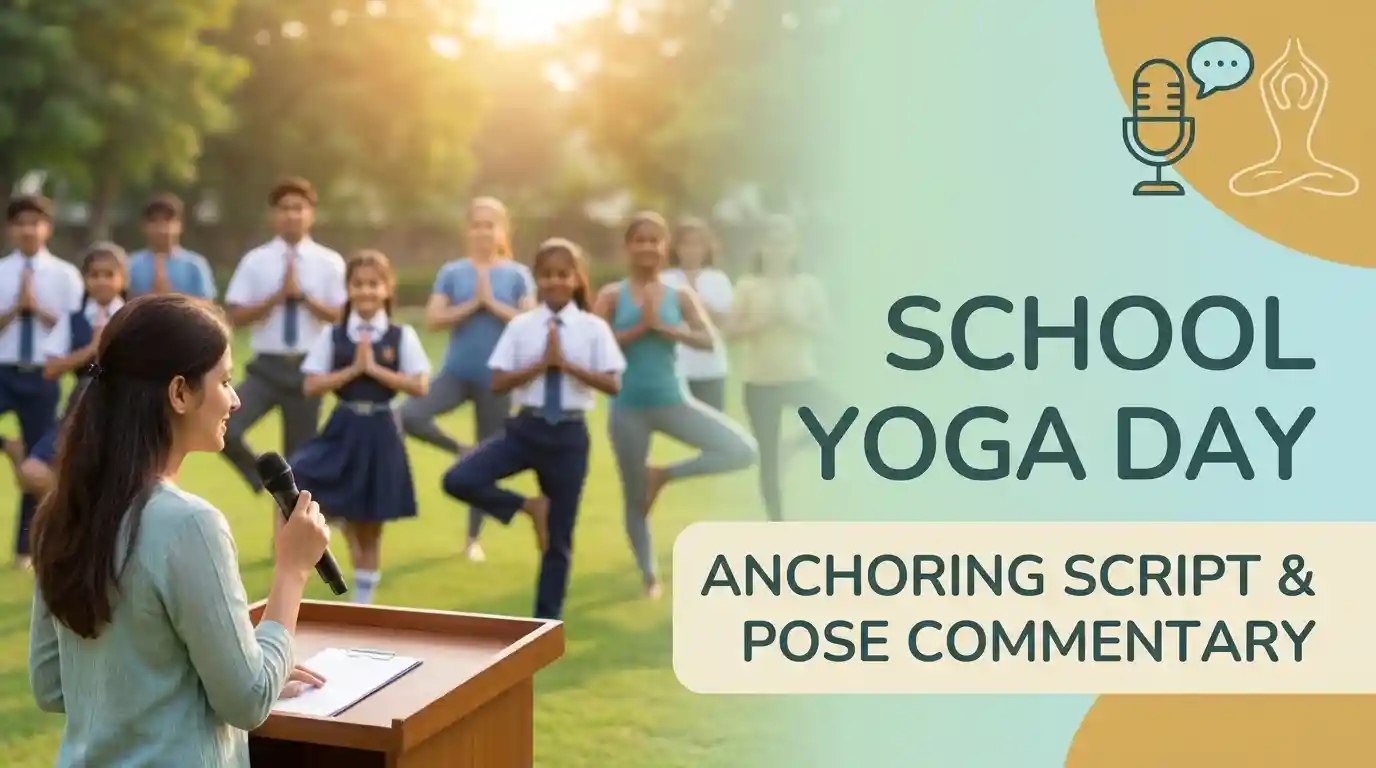
While the Yoga Instructor is demonstrating, the anchor must guide the audience. Use a very calm, slow, and soothing voice. Pause between sentences.
Anchor 1: “We will begin our protocol with basic breathing and warm-ups. Close your eyes. Keep your spine straight. Take a deep breath in… and exhale slowly. Let go of all the tension.”
Anchor 2: “Our first posture is the Tadasana or the Palm Tree Pose. Please observe the instructors on the stage. Slowly raise your hands, interlock your fingers, and lift your heels. This asana improves posture and brings physical and mental balance.”
Anchor 1: “Moving on to the Vrikshasana or the Tree Pose. Focus your eyes on a single point in front of you. This pose is a beautiful reminder to stay grounded like the roots of a tree, even when the winds of life try to shake us.”
Anchor 2: “We will now perform the Anulom Vilom Pranayama (Alternate Nostril Breathing). Inhale deeply from the left nostril, exhale from the right. This simple breathing technique purifies our nervous system and instantly calms the chaotic mind.”
🕊️ Phase 4: The Sankalp (Pledge) & Closing
Conclude the session with a pledge to make Yoga a daily habit, followed by the National Anthem.
Anchor 1: “As we slowly open our eyes and bring our awareness back to this ground, I request everyone to sit straight and join your hands in front of your heart.”
Anchor 2: “Let us take a Sankalp—a pledge—together: ‘I commit myself to remain in a balanced state of mind at all times. I commit to do my duty towards myself, my family, at work, to society, and to the world.’“
Anchor 1: “Yoga is not about touching your toes; it is about what you learn on the way down. Let us not limit Yoga to just the 21st of June, but make it a part of our daily lives.”
Anchor 2: “To conclude our International Yoga Day celebrations, I request everyone to please stand in attention for the National Anthem.”
The Anchor’s Cheat Sheet for Yoga Day
- The “FM Radio” Voice: Your voice should sound like a late-night radio host – deep, soft, slow, and extremely soothing. If you speak too fast, you will break the meditative atmosphere of the crowd.
- Learn the Pronunciations: If you are saying words like Pranayama, Vrikshasana, or Bhujangasana, practice them 10 times at home. Mispronouncing Sanskrit terms on the mic sounds very unprofessional.
- Watch the Crowd: During the Live Commentary, do not just read the paper. Look at the students. If they are taking time to get into a pose, slow down your script. Your words must match their physical movements.