National Youth Day Skit Script 2026: Swami Vivekananda Drama (English)
Speeches are good, but a Drama (Skit) brings history to life. This National Youth Day (January 12), schools are looking for something different to present on stage.
If you want to showcase the life and teachings of Swami Vivekananda through a play, you are in the right place. Below is a powerful 5-Minute Skit Script titled “The Awakening“ that connects Swami Vivekananda’s ancient wisdom with the problems of modern youth.
Why Perform a Skit on National Youth Day?
Every year on January 12, India celebrates the birth anniversary of Swami Vivekananda as National Youth Day (Yuva Diwas). Most schools and colleges organize a special assembly to mark this occasion. Usually, these assemblies are filled with long, monotonous speeches that students often find boring.
This year, why not change the trend? Instead of a speech, present a Drama (Skit).
A skit is a powerful medium because it is visual. When students see their own problems—like mobile addiction, exam stress, and lack of focus—being enacted on stage, they connect instantly.
And when they see Swami Vivekananda offering solutions to these modern problems, the message hits home much harder than a textbook quote.
About This Script:
“The Awakening” This script is specifically designed for school students. It does not require expensive props or complex sets. It is a “Nukkad Natak” (street play) style performance that focuses on dialogue and emotion.
- Theme: Modern Youth vs. Ancient Wisdom.
- Duration: 5 to 7 Minutes.
- Message: “Arise, Awake, and Stop Not.”
Below is the complete script. Read it, memorize it, and get ready to rock the stage.
Script Details
- Title: The Awakening (Jaago Yuva)
- Characters:
- Student 1 (Rahul): Stressed about exams, addicted to phone.
- Student 2 (Amit): Confused about his career.
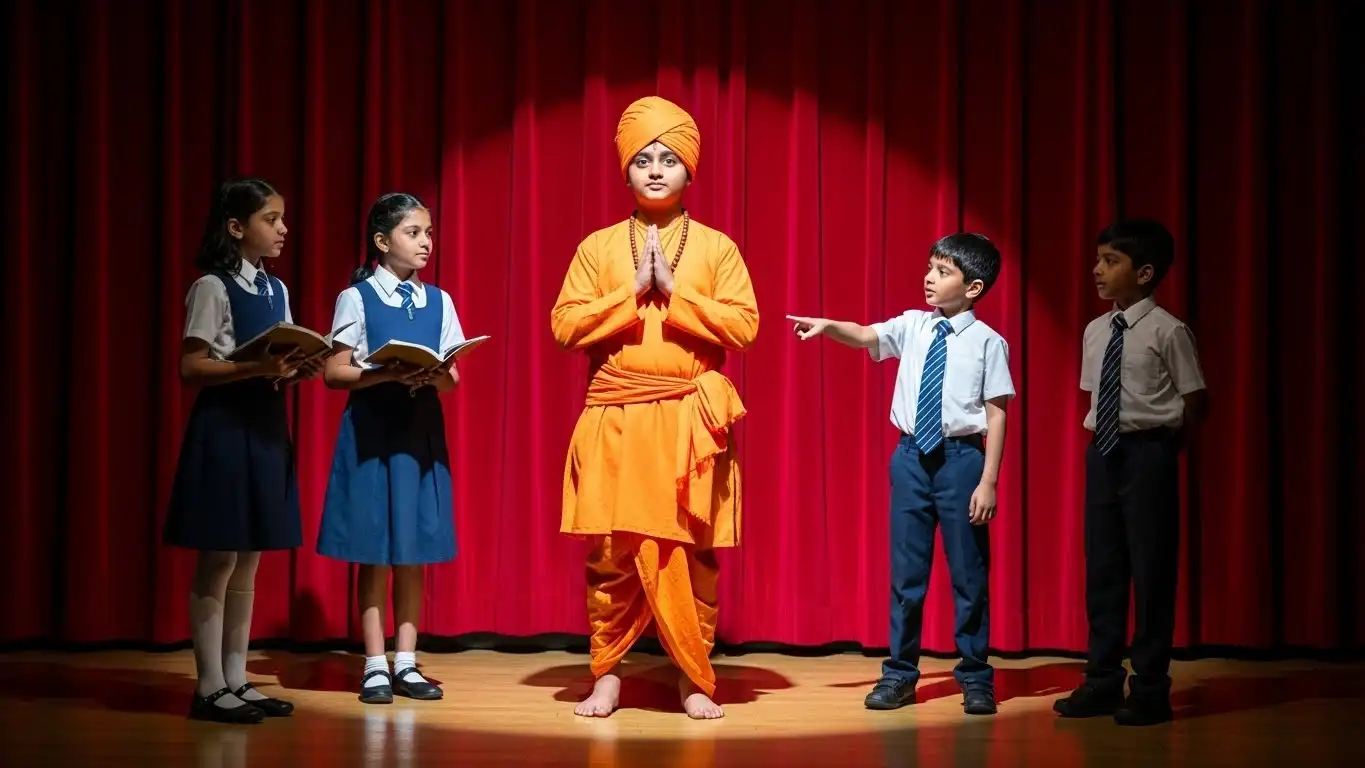
- Swami Vivekananda: (A student dressed in orange robes).
- Narrator: Hosts the play.
Scene 1: The Confused Youth
(Stage opens.) Rahul and Amit are sitting on a bench, looking sad.)
Narrator: “Our story begins with two modern students, Rahul and Amit. They have technology, but they lack peace.”
Rahul: “I can’t do this, Amit. The exams are coming, and I can’t focus. I just scroll Instagram all day.”
Amit: “Same here. I want to do something big, but I feel so weak. Everyone says India is a young country, but what are we actually doing?”
Rahul: “I wish we had a guide. Someone to show us the way.”
(Suddenly, a bright light flashes/music plays.) Swami Vivekananda enters.)
Scene 2: The Encounter
Swami Vivekananda: “Why do you cry, my children? All power is within you; you can do anything and everything.”
Rahul (Scared): “Who are you?”
Swami Vivekananda: “I am the voice of your own soul. I am the belief that you have forgotten.”
Amit: “But Swamiji, we are stressed. We have pressure.”
Swami Vivekananda: “Pressure? My child, ‘The greatest sin is to think yourself weak.’ You are lions, not sheep! Shake off the delusion that you are weak. Arise, awake, and stop not until the goal is reached!”
Scene 3: The Chicago Lesson
Amit: “But Swamiji, the world is so divided. People fight over religion and caste.”
Swami Vivekananda: “I spoke about this in Chicago in 1893. I said, ‘Sisters and Brothers of America…’ Sectarianism, bigotry, and fanaticism have long possessed this beautiful earth. It is time to end it.”
Rahul: “So, what should we do?”
Swami Vivekananda: “Love your country. Serve the poor. If you want to find God, serve man. ‘Jiva is Shiva.’ Go back to your books, not for marks, but for knowledge. Go back to the playground, for you will be nearer to Heaven through football than through the study of the Gita.”
Scene 4: The Transformation
(Swami Vivekananda walks away slowly.)
Rahul (standing up): “He is right. Why was I scared? I have the power to change my future.”
Amit: “Yes! Let’s promise today. We will not waste our youth. We will build a strong India.”
Narrator: “And thus, the sleeping lions awoke. The message of Swami Vivekananda is not just for history books; it is for YOU.”
(All actors come to the front and bow.)
All together: “Jai Hind!”
Tips for a Better Performance
- Costume: Ensure the student playing Swami Vivekananda wears the authentic orange turban and robes.
- Audio: Play a thunder sound effect when Swamiji enters to make it dramatic.
- Voice: The student playing Swamiji should speak slowly and loudly.
Director’s Notes: How to Stage This Play Effectively
A script is just paper; the performance makes it magic. If you are the teacher or student director in charge of this play, here are 4 professional tips to ensure the audience is mesmerized:
1. The “Swamiji” Entry (The Wow Moment)
The entry of Swami Vivekananda in Scene 2 is the climax of the play. It must be dramatic.
- Lighting: If you are in an auditorium, dim the main lights and use a single “Spotlight” on Swamiji when he enters.
- Sound: Do not let him enter in silence. Play a loud “Shankh Naad” (Conch Shell sound) or deep instrumental meditation music as he walks in.
- Posture: The student playing Swamiji must not walk fast. He should walk slowly, with folded arms (his signature pose), head held high, and a calm smile.
2. The Contrast in Body Language
The success of this play depends on the contrast between the “Modern Students” and “Swamiji.”
- Rahul & Amit: They should sit with slouched shoulders, looking tired and anxious. They should look at their phones constantly.
- Swamiji: He must stand perfectly straight like a pillar. He should never look at the ground.
3. Voice Modulation is Key
- Rahul/Amit: Should speak fast, in a complaining and whining tone.
- Swamiji: Should speak slowly, with deep bass in his voice. Every word should have a pause after it. For example: “Arise… (pause)… Awake… (pause)… and stop not!”
4. The Final Bow (Curtain Call)
At the end, when everyone shouts “Jai Hind,” ensure the energy is at 100%. Don’t just say it; scream it with pride. The audience will automatically clap if the ending is high-energy.
Frequently Asked Questions (FAQs)
Q1: Can girls play the role of Swami Vivekananda?
Ans: Absolutely! In school plays, gender does not matter. A girl with a strong voice and good height can play the role perfectly. Just ensure the turban and robes are tied correctly.
Q2: Can we add more characters to the script?
Ans: Yes. If you have a large group, you can add more “Confused Students” in Scene 1. One can be stressed about sports, another about parents’ pressure. Swamiji’s answers can remain the same as his teachings apply to all problems.
Q3: Where can I get the costume?
Ans: You don’t need to buy an expensive costume. You can use two saffron (orange) dupattas or sarees. Use one to wrap around the body as a robe and the other to tie the turban.
Q4: Is this suitable for primary school kids?
Ans: Yes, but you might want to shorten the dialogues in Scene 3 (The Chicago Lesson) as younger kids might find difficult words like “sectarianism” hard to pronounce.
Conclusion
Swami Vivekananda believed that the youth are the powerhouse of the nation. By performing this skit, you are not just entertaining your school; you are waking up the sleeping lions in the audience. Rehearse well, speak loud, and let the message echo in everyone’s heart.
Happy National Youth Day!