Martyrs Day Anchoring Script For School 2026: School Assembly (Jan 30)
Understanding the Gravity of Martyrs’ Day (Jan 30)
In the Indian school calendar, January 30 holds a unique place. It is not a holiday; it is a day of observance. On this day in 1948, Mahatma Gandhi was assassinated at Birla House in New Delhi.
To honor him and all the freedom fighters who sacrificed their lives for India, the nation observes Martyrs’ Day (Shaheed Diwas).
For a school anchor, this is perhaps the most difficult assembly to host. Why? Because unlike other events where you can shout slogans or crack jokes to keep the audience engaged, today you must command attention through silence and gravity.
The highlight of this assembly is the Two-Minute Silence, which is traditionally observed nationwide at 11:00 AM. As an anchor, it is your responsibility to ensure this silence is maintained with absolute discipline. A single giggle or disturbance from the audience can ruin the solemnity of the occasion.
This article provides you with a step-by-step anchoring script designed to maintain a respectful atmosphere. It guides you on what to say, how to pause, and how to transition smoothly between the floral tributes and the speeches.
While January 26th is a day of parade and pride, January 30th is a day of silence and remembrance. Known as Martyrs’ Day (Shaheed Diwas), this date marks the death anniversary of the Father of the Nation, Mahatma Gandhi.
Know the significance of Shaheed Diwas
Schools across India observe a special assembly to pay homage to the freedom fighters. If you are the anchor for this solemn occasion, your tone must be respectful and calm. Below is a complete Martyrs’ Day Anchoring Script for schools.
Part 1: The Solemn Introduction
Anchor 1: “Good morning to the respected Principal, teachers, and students.”
Anchor 2: “Today is not a day of celebration, but a day of remembrance. On this day in 1948, the light of our nation, Mahatma Gandhi, left us. We observe this day as Martyrs’ Day or Shaheed Diwas.”
Anchor 1: “We are gathered here not just to mourn, but to honor the sacrifices of Bapu and countless other brave souls who laid down their lives for our freedom.”
Part 2: Floral Tribute (Pushpanjali)
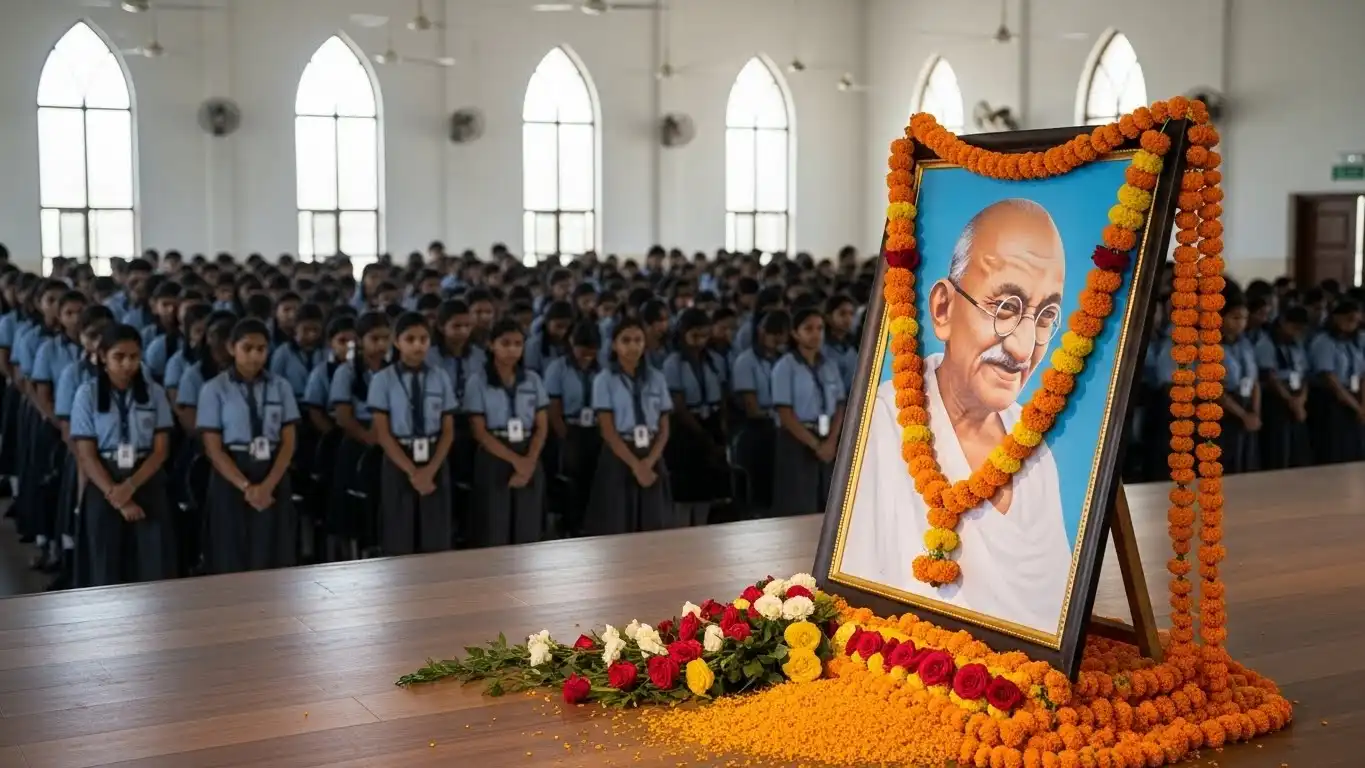
Anchor 2: “To pay our respectful homage, I invite our Principal Sir/Ma’am to offer flowers to the portrait of Mahatma Gandhi.”
(Soft patriotic instrumental music can be played)
Anchor 1: “Gandhiji famously said, ‘My life is my message.’ Today, let us reflect on his message of Truth (Satya) and Non-violence (Ahimsa).”
Part 3: The 2-Minute Silence (The Most Important Part)
Note for Anchors: This is the central part of the assembly, usually observed at 11:00 AM.
Anchor 1: “I now request everyone to stand straight for the observance of silence.”
Anchor 2: “Let us observe a two-minute silence in memory of those who gave their todays for our tomorrows.”
(Silence for 2 Minutes)
Anchor 2: “Om Shanti. Thank you. You may now sit down.”
Part 4: Speech / Patriotic Song
Anchor 1: “To express our gratitude through words, I invite [Student Name] to deliver a short speech on ‘The Relevance of Gandhi in 2026’.”
(After the speech)
Anchor 2: “Thank you for those moving words. Now, the school choir will present a favorite bhajan of Bapu, ‘Raghupati Raghav Raja Ram’.”
Part 5: Vote of Thanks & Dismissal
Anchor 1: “As we end this assembly, let us carry the spirit of sacrifice in our hearts.”
Anchor 2: “I thank our Principal and teachers for their presence. The assembly is now dismissed. Please move to your classes in silence.”
Anchor’s Guide: How to Maintain Solemnity on Stage
Hosting a mourning ceremony (Shok Sabha) is very different from hosting a cultural fest. Your usual anchoring tricks will not work here. Here are 4 critical tips to ensure you conduct this assembly perfectly:
1. The “Low Pitch” Voice Technique Today, your voice should not be loud or high-pitched. Drop your volume slightly and speak slower than usual.
- Bad Example: “GOOD MORNING EVERYONE! WELCOME TO MARTYRS’ DAY!” (Too energetic)
- Good Example: “A solemn good morning to all… Today, we gather with heavy hearts…” (Calm and composed)
2. Managing the “2-Minute Silence” This is the most critical part of the script. Two minutes can feel very long to a student audience.
- The Start: When you say “Let us observe silence,” wait for 5 seconds for the shuffling to stop before you start the timer.
- The End: Do not just say “Okay, stop.” Gently break the silence with a soft phrase like “Om Shanti” or “Thank you.”
- Body Language: During the silence, bow your head slightly. Do not look around or check your phone/watch visibly.
3. Music Selection Background music is essential for this assembly. Do not play upbeat patriotic songs like “Maa Tujhe Salaam.” Stick to:
- Raghupati Raghav Raja Ram (Slow Instrumental)
- Vaishnav Jan To (Gandhiji’s favorite)
- Aye Mere Watan Ke Logon (Instrumental)
4. Dress Code This is strict. If you are the anchor, wear a neat, ironed school uniform. If you are allowed to wear civil clothes, stick to White (Kurta/Salwar) as it symbolizes peace and mourning. Avoid bright colors like neon, red, or black.
Frequently Asked Questions (FAQs)
Q1: Is January 30 the only Martyrs’ Day?
Ans: No. India actually observes Martyrs’ Day on two dates. January 30 (Gandhi’s Death Anniversary) and March 23 (Execution of Bhagat Singh, Sukhdev, and Rajguru). This script is specifically for the January 30 observance involving Mahatma Gandhi.
Q2: Can we perform a skit on Martyrs’ Day?
Ans: Yes, but it must be serious. A skit depicting the Dandi March or the non-violent protests of Gandhiji is appropriate. Avoid loud battle scenes or violent enactments on this specific day.
Q3: What if students make noise during the silence?
Ans: As an anchor, do not scold them on the mic. Maintain your own silence and posture. Usually, the discipline in-charge or teachers will handle the crowd. Your breaking character will only distract them more.
Q4: Can we clap after the speech?
Ans: Usually, clapping is avoided in a “Shok Sabha” (Condolence Meeting). However, in a school assembly context, polite/soft applause after a speech is acceptable. Avoid loud cheering or whistling.
Conclusion
Martyrs’ Day is a reminder that our freedom came at a great cost. As you walk off the stage today, ensure that the students leave with a sense of gratitude, not just the joy of missing a class. Use this script to create an atmosphere of respect that Bapu deserves.
Jai Hind.