National Girl Child Day Anchoring Script 2026: Speech & Pledge (Jan 24)
“When girls are educated, their countries become stronger and more prosperous.”
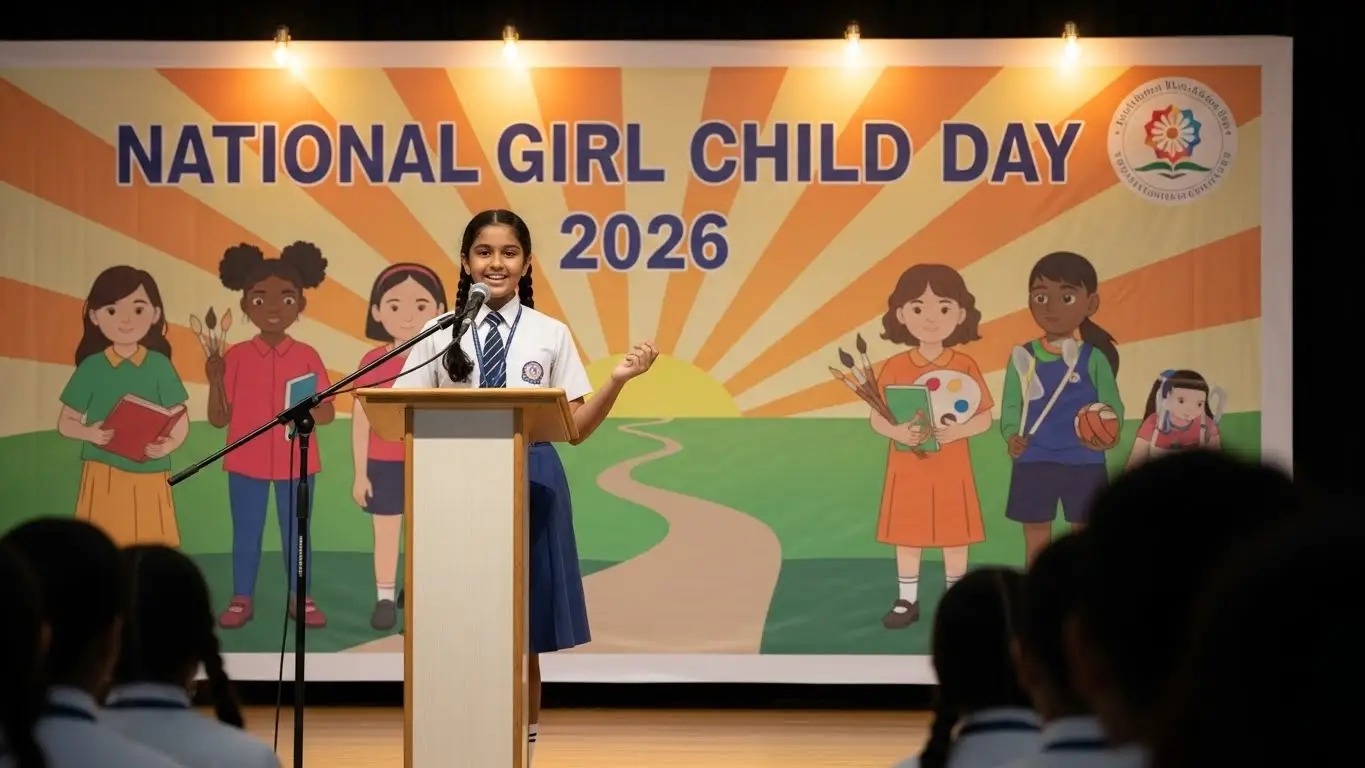
Every year on January 24, India celebrates National Girl Child Day (Rashtriya Balika Diwas). For schools and colleges, this is not just another date on the calendar; it is a mandatory observance directed by the government to promote awareness about the rights of the girl child.
If you have been selected as the anchor for this special assembly, you might be wondering: What is the right tone for this event? Should it be sad? Should it be angry?
The answer is: It should be Empowering.
We celebrate this day because on January 24, 1966, Indira Gandhi took charge as the first woman Prime Minister of India. It is a day to remind every student that a girl can reach the highest office in the land.
This article provides a complete, structured Anchoring Script for National Girl Child Day 2026. It covers everything from the “Beti Bachao” message to the solemn pledge. We have also included a special “Director’s Guide” at the end to help you manage the stage with confidence.
National Girl Child Day Anchoring Script (Jan 24)
(Scene: The stage is decorated with posters of famous Indian women. Anchors walk in with energy.)
Part 1: The Empowering Introduction
Anchor 1: “Good morning to the Respected Principal, dedicated teachers, and all the shining stars of our school.”
Anchor 2: “Today is January 24, a day dedicated to the strength, resilience, and potential of the daughters of India. We are celebrating National Girl Child Day (Rashtriya Balika Diwas).”
Anchor 1: “This day is a reminder that a girl is not a burden; she is the creator of the future. From the boxing ring of Mary Kom to the space missions of Kalpana Chawla, Indian women have proved that the sky is not the limit.”
Part 2: Lighting the Lamp (Vidya Deep)
Anchor 2: “To honor the Goddess of Knowledge and Power, I request our Principal Ma’am to light the ceremonial lamp.”
Anchor 1 (Hindi Shayari during lighting):
“Komal hai kamzor nahi, tu shakti ka naam hai,
Naari ko jeevan dene wala, har sansaar pranaam hai.”
Anchor 2: “As the flames rise, let us pray that the darkness of gender discrimination vanishes from our society forever.”
Part 3: The Awareness Speech
Anchor 1: “The government has launched initiatives like ‘Beti Bachao, Beti Padhao‘ (Save the Daughter, Educate the Daughter). To tell us more about why this is important, I invite [Student Name] to the stage.”
(After the speech)
Anchor 2: “Thank you for that eye-opening speech. It is true—when you educate a boy, you educate an individual. But when you educate a girl, you educate an entire family.”
Part 4: The Pledge (The Most Important Part)
Note: This is a mandatory part of the Jan 24 assembly in most schools.
Anchor 1: “I now request everyone to stand up and raise their right hand. Let us take a pledge to protect and respect the girl child.”
Anchor 2 (Recite slowly):
“I pledge to treat all girls with respect and dignity.
I will stand against gender discrimination in my home and society.
I promise to support the education of the girl child.
Because when a girl rises, the nation rises.
Jai Hind!”
Part 5: Vote of Thanks & Conclusion
Anchor 1: “As we conclude today’s assembly, let us carry this promise in our hearts.”
Anchor 2: “Happy National Girl Child Day to all the wonderful girls here. You are strong, you are capable, and the world is yours.”
Anchor 1 & 2: “Jai Hind!”
Director’s Guide: How to Host This Event Perfectly
A script is just words on paper. To make this event successful, you need the right presentation. Here are 4 expert tips to help you host the National Girl Child Day assembly like a pro:
1. The Visual Theme (Dress Code)
Since this day represents female empowerment, visual symbolism is powerful.
- For Anchors: If you are allowed, wear a Pink or Purple ribbon or sash. These colors are globally associated with girl child awareness.
- Stage Decor: Ask the art department to place a collage of famous Indian women (Indira Gandhi, Lata Mangeshkar, P.V. Sindhu) on the podium.
2. The Tone of Voice
This is the most common mistake anchors make on this day.
- Don’t: Sound sad, depressed, or sympathetic. Do not act like girls are “victims.”
- Do: Sound Proud and Energetic. You are celebrating their achievements. When you say the Shayari, speak with “Josh” (Passion).
3. Handling the Pledge
The pledge in Part 4 can get messy if not coordinated.
- The Trick: Read the pledge in short bursts. Say “I pledge…” and wait for the students to repeat. Say “To treat all girls…” and wait again. If you read the whole sentence at once, the assembly will become noisy and confused.
4. Interactive Question (Filler)
If the Chief Guest is late or the next performance isn’t ready, use this filler question to engage the audience:
- Anchor: “Who can name the first Indian woman to win an Olympic Medal?” (Wait for answers).
- Answer: “Karnam Malleswari!”
- This keeps the energy high and educates the students at the same time.
Frequently Asked Questions (FAQs)
Q1: Is National Girl Child Day the same as International Day of the Girl Child?
Ans: No. National Girl Child Day is celebrated in India on January 24. The International Day of the Girl Child is celebrated globally on October 11. Be careful not to mix them up in your speech!
Q2: Can boys be anchors for this event?
Ans: Absolutely! In fact, having a boy anchor (Anchor 1) and a girl anchor (Anchor 2) sends a powerful message of gender equality. It shows that protecting the girl child is a shared responsibility.
Q3: Can I add a dance performance to this script?
Ans: Yes. A dance on songs like “Badal Pe Paon Hai” (Chak De India) or “Aigiri Nandini” (Classical/Power) fits perfectly between Part 3 and Part 4.
Q4: Is the pledge mandatory?
Ans: While not legally mandatory, most schools follow the circulars from the CBSE or State Boards which often recommend a “Beti Bachao Oath” on this day. It is highly recommended to include it.