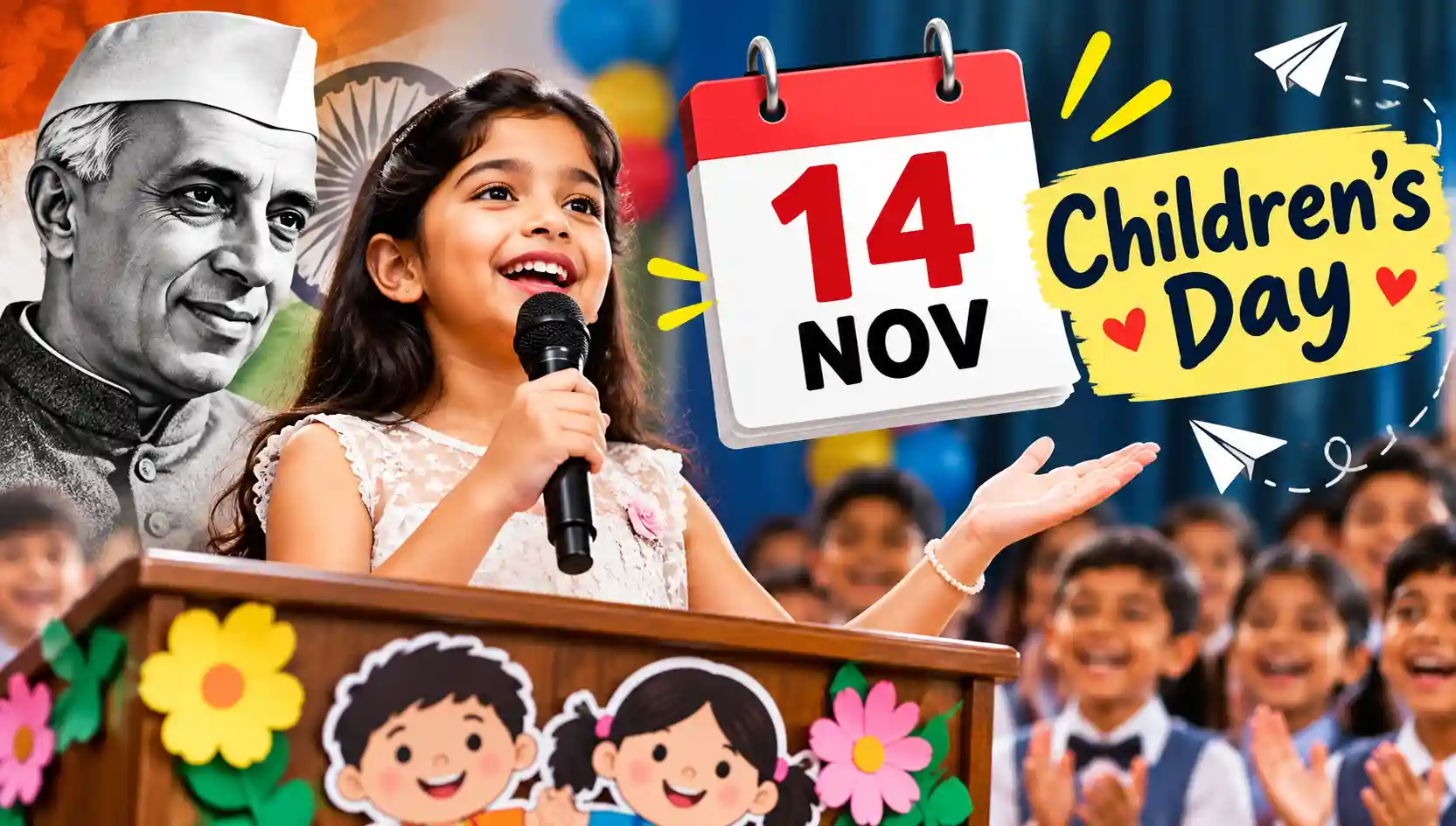
14 November is Close – Here’s a Perfect Children’s Day Anchoring Script
Children’s Day – 14 November – is one of the most energetic events on any school calendar.
The crowd is already in a good mood. The students are performing. The teachers are watching with quiet pride.
And then the anchor walks on stage and says: “Good morning, respected principal ma’am, respected teachers, and my dear fellow students. Today we are gathered here to celebrate Children’s Day…”
The crowd switches off.
Not because they don’t care. Because they’ve heard this exact opening every single year – at this school, at every school, from every anchor who copied the same template.
This article gives you a complete Children’s Day anchoring script built for the actual energy of the event.
Why Most Children’s Day Scripts Fail
The problem isn’t preparation. Most students prepare.
The problem is that every anchor copies the same structure: formal welcome, Nehru quote, lamp lighting – in the exact same order, with the exact same phrases.
Children’s Day has a specific mood. It’s celebratory, warm, slightly nostalgic. An anchoring script that sounds like a Republic Day script wastes that mood entirely.
The fix is straightforward: match your opening to the feeling of the day.
The Opening That Actually Works
Forget “Good morning.” Start with a line that puts the audience inside a memory.
Use this directly:
“Do you remember the first time you stood on this stage? Maybe your hands were shaking. Maybe you forgot your lines. Maybe you just stood there, smiling, because you were six years old and that was enough. Today, on Children’s Day, we celebrate the version of us that didn’t overthink it.”
Pause. Let it land.
Then bring in Nehru – but use his actual words, not a paraphrase:
“Jawaharlal Nehru once said: ‘The children of today will make the India of tomorrow.’ We are that tomorrow. And this stage is ours.”
Now do your formal welcome – principal, teachers, guests. By this point, the audience is already with you. The formalities land differently when trust is already built.
Segment-by-Segment Script
Introducing the first performance:
“Our first performance today comes from Class [X]. They’ve been rehearsing for three weeks – and if you watch closely, you’ll see exactly why Chacha Nehru believed in children so much. Please welcome them to the stage.”
Never just say “Please welcome Class X.” Add one specific detail. It takes five seconds and makes the transition feel personal, not mechanical.
Between performances (technical pause):
“While Class [X] makes their way off stage, I want to ask – how many of you still remember your first school play? Hold that thought. Our next performance is about to remind you.”
Most anchors go silent during technical pauses. This fills the gap without feeling forced.
Teacher appreciation segment (if applicable):
“Children’s Day isn’t only about students. It’s also about the people who chose to spend their careers in a room full of us – our teachers. Today, we take a moment to say thank you. Not because the calendar says so. Because we actually mean it.”
Closing the event:
“Every generation of students has stood on this stage. Every one of them grew up, moved on, and carried something from this school with them. Today was our turn. On behalf of everyone who performed, thank you for being here.”
Then thank the principal, teachers, and guests – and close.
The One Mistake That Kills Children’s Day Anchoring
Rushing transitions.
Good anchoring is not just about reading the next item. ScriptWala recommends using clear transition lines and adjusting your pace to match the moment, so the event feels connected instead of becoming a series of rushed announcements.
Give every transition at least 15 seconds. Use those seconds to plant a thought, ask a question, or build anticipation.
It’s the difference between an event that feels rushed and one that feels curated.
Three Things to Do Before You Walk On Stage
1. Know the full running order – not just your lines. Know which class performs when, what they’re performing, and roughly how long each item runs. Surprises kill your confidence mid-event.
2. Prepare two filler lines – for when a performance is delayed or a mic fails. Example: “While we get set up backstage, turn to the person next to you and tell them one thing you’re grateful for this school year. You have 30 seconds.” It sounds intentional. Nobody knows it’s a gap-filler. As public speaking experts from organizations like Toastmasters recommend, having graceful recovery lines prepared is crucial to maintaining your composure on stage.
3. Don’t over-memorize – Know your structure. Know your transitions. But don’t lock every word in. If you blank mid-line, a rigid script makes recovery harder, not easier.