You’ve been chosen to anchor the Teacher’s Day function. The mic is in your hand. And suddenly, you realise — this one is different.
You’re not anchoring for the teachers. You’re anchoring in front of them.
That changes everything. The tone has to be warmer. The words have to feel genuine. And unlike an Annual Day, there’s no Chief Guest to carry the weight — the teachers are the guests of honour.
This is your complete Teacher’s Day anchoring script for 2026, written for two anchors in the English-Hindi (Hinglish) style that Indian school and college audiences actually respond to. Scroll to the script, follow the pro tips, and you’ll walk off that stage with confidence.
Also Read: Best Opening Lines for an Anchoring Script (2026)
| Segment | Time | Speaker | Notes |
|---|---|---|---|
| Prayer | 3 min | Choir | Everyone stands |
| Lamp lighting | 5 min | Principal | Music low |
| Felicitation | 15 min | Anchors | One line per teacher |
What Makes a Teacher’s Day Script Different?
Most anchoring scripts follow a pattern: Welcome → Performance → Speech → Close. Teacher’s Day breaks that pattern in three ways.
The tone is emotional, not just formal
Teachers have seen hundreds of functions. Generic lines won’t move them. Your words need to feel personal and warm — not like you’re reading from a textbook.
The felicitation segment is the centerpiece.
Unlike an Annual Day where performances are the highlight, on Teacher’s Day, the moment a teacher walks up to receive a shawl or a memento is the highlight. Build up to it.
The student–teacher dynamic is reversed
For one day, students are in charge. That’s a big deal. Acknowledge it, have a little fun with it — but stay respectful.
Keep these three things in mind and your script will stand out from every other generic one.
Full Teacher’s Day Anchoring Script 2026 (Two Anchors)
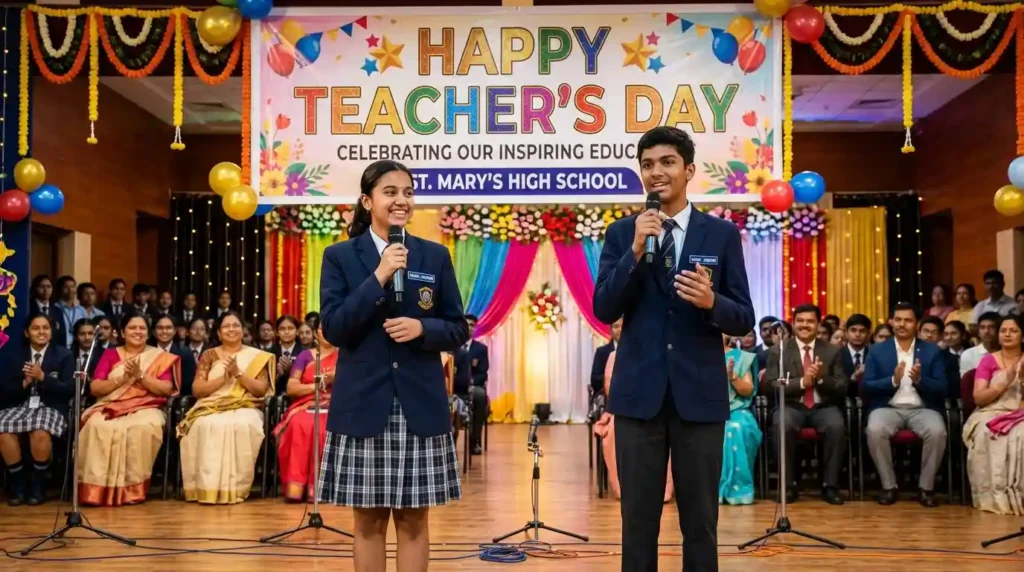
This script is designed for Anchor 1 (A1) in English and Anchor 2 (A2) in Hindi/Hinglish, the code-switching style that works best in Indian schools and colleges. Customise names, class details, and your school’s programme order as needed.
Opening — Setting the Tone
A1: “Good morning to our respected teachers, the non-teaching staff, and my dear friends! A very, very warm welcome to all of you on this special day — the 5th of September — Teacher’s Day 2026.“
A2: “Namaskar! Aaj ka din sirf ek tyohar nahi hai. Aaj ka din ek ehsaan ko yaad karne ka din hai — un logon ka ehsaan, jinhone humein sirf padhaya nahi, balki zindagi jeena sikhaya.”
(Translation: Today is not just a celebration. Today is a day to remember a favour — the favour of those who did not just teach us, but taught us how to live.)
A1: “Today, we celebrate the birth anniversary of Dr. Sarvepalli Radhakrishnan — philosopher, statesman, and one of the greatest teachers India has ever produced.
(Quick anchor tip: If you want to say something more personal about him in your intro, here’s a short read on why his birthday became Teacher’s Day — one compelling story from it can make your opening unforgettable.)”
A2: “I request everyone to please stand and join us as we begin with the School Prayer.”
(School Prayer)
A1: “Please be seated. What a beautiful start to a beautiful day.”
Lamp Lighting Ceremony
A2: “Roshan karo in diyano ko, jaise aap ne roshan kiye hain hamare andheron ko. I now request our respected Principal Sir/Ma’am, along with our senior teachers, to kindly come forward for the Lamp Lighting Ceremony.”
A1: “Just as a single candle can light a thousand others without losing its own flame — that is exactly what a teacher does. Please give a warm round of applause.”
(Lamp Lighting)
A2: “Thank you. Please be seated. What you just witnessed is not just a ceremony — it is a symbol.”
Principal’s Address
A1: “To inspire us with some words of wisdom — because who better to do that on Teacher’s Day than a teacher himself/herself — I would like to invite our Respected Principal, [Name], to the podium. Sir/Ma’am, the stage is yours.”
(Principal’s Speech)
A2: “Bahut bahut shukriya, [Principal name] sir/ma’am. Aap ke shabd hamesha hamare saath rahenge.”
Cultural Performances — Transition Lines
Use these lines to introduce performances. Each one sets a different mood — pick what fits your programme.
For a Welcome Dance:
A1: “Our students have prepared something special — not just to entertain, but to say ‘thank you’ through their art. Please welcome Class [X] to the stage for a beautiful Welcome Dance.”
For a Skit or Drama:
A2: “Kuch cheezein words mein nahi keh sakte. Isliye hamari drama team aaj apne performance ke zariye kuch kehna chahti hai. Aankhein khuli rakhein — message gehri hai.”
A1: “A big round of applause for the students of Class [X] as they present their skit.”
For a Song or Choir:
A1: “Music can say what words cannot. Our choir today has chosen a song that every student in this room feels in their heart. Please put your hands together.”
For a Poem Recitation:
A2: “Kavita mein woh taqat hoti hai jo seedha dil tak pohonchti hai. Suniye dhyan se — aaj ki kavita khas hai.”
Felicitation of Teachers — The Heart of the Day
This is the most important segment. Do not rush it. Pause. Let the moment breathe.
A1: “And now, we come to the moment that this entire day has been building towards.”
A2: “Humare kuch students aaj apne teachers ko ek chhota sa gift dena chahte hain. Gift chhota ho sakta hai — lekin ehsaan chhota nahi hoga.”
A1: “I request [Name of Student In Charge] to please come forward and begin the felicitation. Teachers, this one is for you.”
(Felicitation takes place — call each teacher’s name, allow time for applause)
Pro-tip: After each teacher receives the gift, say something warm and specific — even one line. For example:
- “[Teacher Name] — the person whose ‘Read the chapter again’ made us actually understand it.”
- “[Teacher Name] — the one whose class we actually looked forward to.”
- “[Teacher Name] — strict in class, kind at heart. Thank you, sir/ma’am.”
These personalised touches are what teachers remember for years.
Vote of Thanks / Closing
A2: “Aaj ki shaam yahaan tak pohonchne ke liye, kaafi logon ne mehnat ki. Sabse pehle — thank you to our Principal, [Name], for always supporting every student initiative.”
A1: “A heartfelt thank you to every teacher present here today. You show up for us every single day. Today, we wanted to show up for you.”
A2: “Thank you to our organising committee — [Name] and the team — for putting this programme together. And thank you to every student who performed, decorated, or simply sat here and clapped.”
A1: “On behalf of every student in this school, we want to say one final thing. You may not know how many lives you’ve changed. But we do. And we are grateful.”
A2: “Aap ne jo diya, woh na koi school syllabus mein hai, aur na kisi exam mein aata hai. Woh zindagi ka syllabus hai. Thank you.”
Both: “Happy Teacher’s Day 2026! Jai Hind!”
5 Filler Lines for When There’s a Delay
Every function has a moment when the next performer isn’t ready. Here are five lines to keep the energy alive:
- “That performance was so good, I think we need one more round of applause — just to be sure.”
- “Did you know — in ancient India, a Guru’s birthday was celebrated for a full month? We’re giving our teachers one day. That’s our first homework assignment: do better.”
- “While the next segment gets ready, I want to ask — who here has a teacher they still think about years later? That’s the power of a great teacher.”
- “Our next performers are just adding some last-minute emotions to their performance. Relatable, honestly.”
- “Sir/Ma’am, if you’re watching — this pause is dedicated to every time you waited patiently while we finished copying notes.”
Common Mistakes Anchors Make on Teacher’s Day
Reading the script word-for-word.
Teachers can tell. Practice until the script is in your head, not on a paper. Glance — don’t read.
Being too formal, too stiff.
Yes, this is a respectful occasion. But warm and respectful is possible. Don’t sound like you’re reading a legal document.
Skipping the personalised touches during felicitation.
Generic announcements (“and now Teacher Number 3 comes up”) are forgettable. One genuine line about each teacher makes the whole programme memorable.
Rushing through the closing.
The closing is your last impression. Slow down. Let the final words land.
Not practising transitions
The gap between performances is where most anchors stumble. Know exactly what you’re saying before the next group walks on stage.
Pro Tips for Anchoring Teacher’s Day
1. Use a teacher’s quote as your hook.
Open with a quote from a famous teacher — Dr. Radhakrishnan, APJ Abdul Kalam, or even a quote from a teacher in your own school. It sets the emotional tone immediately.
2. The “reverse” technique works well here.
Instead of “on behalf of the teachers, welcome students,” try “on behalf of the students — welcome, teachers. Today, you are our guests.” It’s a small flip that feels intentional.
3. Don’t call it a “small token.”
When introducing the felicitation, avoid “we have a small gift for you.” It undersells the moment. Say “a token of our love and respect” instead.
4. Pause after emotional moments.
If a poem or a speech lands emotionally, don’t rush into the next line. A 3-second pause says more than any transition line could.
5. End on a standing ovation.
Close by asking the entire audience to stand and applaud the teachers together. It creates a visual moment that everyone remembers.
Frequently Asked Questions (FAQs)
Q1: How long should the Teacher’s Day anchoring script be?
A Teacher’s Day function usually runs between 45 minutes and 1.5 hours. Your spoken anchoring lines should take 10–15% of that time — keep each segment introduction under 45 seconds.
Q2: Can one person anchor the Teacher’s Day programme alone?
Yes. If you’re anchoring solo, simply combine both A1 and A2 lines. You can drop the Hindi lines or keep them — it works either way. A solo anchor should add a few extra filler lines in case of delays.
Q3: What should I wear as a Teacher’s Day anchor?
Dress well but not over the top. Formal Indian wear (kurta, salwar, saree) is generally the best choice — it looks respectful and occasion-appropriate. Avoid flashy accessories that distract.
Q4: Is it okay to add humour to a Teacher’s Day script?
Light, affectionate humour is absolutely fine — and teachers often appreciate it. Avoid sarcasm or anything that could be misread. A gentle joke about homework or exams usually lands well.
Q5: What if I forget my lines mid-programme?
Stay calm. Pause, smile, and say: “Apologies — I’m so moved by today that I almost forgot what to say next.” Then continue. Honesty is always better than awkward silence.
Also Read: Best Comedy Anchoring Script in English 2026 (Funny & Relatable)
Conclusion
A great Teacher’s Day anchoring script doesn’t just announce performances — it creates a feeling. When your teachers walk out of that hall today, they should feel seen, appreciated, and celebrated — not just by the programme, but by your words.
Use this script as your foundation. Personalise the felicitation lines. Add your school’s name. And then practice — not until you get it right, but until you can’t get it wrong.
Want this as a PDF you can print and carry backstage? [Download the Teacher’s Day Anchoring Script 2026 PDF →]