
Best Anchoring Script for Sports Day (March Past & Races)
Most school sports day anchors lose their crowd before the opening whistle blows.
Not because of poor vocabulary.
Because they write an essay for an arena that moves at full sprint.
This guide fixes that.
If you want flat paragraphs from a dusty textbook, skip this. But if you want sharp, field-tested cues that turn nervous silence into raw stadium energy, read on.
The 3 biggest mistakes beginners make on the microphone:
- Reading long paragraphs while athletes are already crossing the finish line.
- Calling house contingents out of sync with the brass band drumbeat.
- Or worst (!!!), freezing on the mic when a track heat gets delayed.
Assume zero broadcasting experience. You can run this directly from cue cards today.
Sounds like a good deal? Cool.
Two rules before starting: print your cue cards single-sided, and sync your eye line with the chief referee.
1. What is an Athletic Anchoring Script?
An athletic anchoring script is not a formal speech.
It is live traffic control with decibels.
You set the rhythm, the stadium follows.
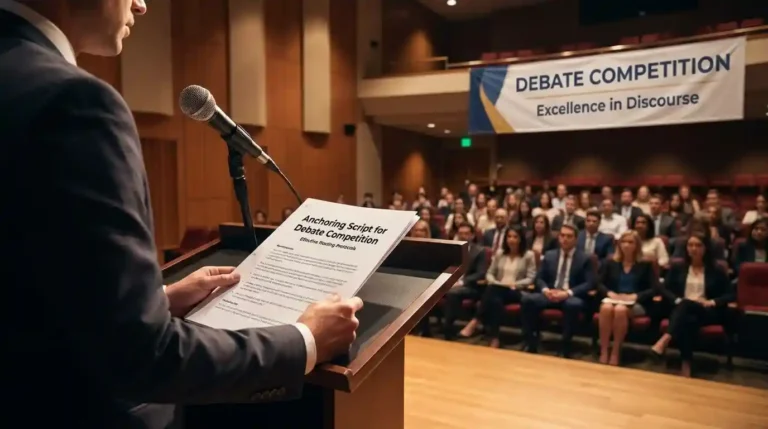
[Image caption: An anchor at the field podium holding single-sided cue cards, scanning the track lanes.]
How it actually works (in 30 seconds)
3 concepts keep you ahead of the action:
- Visual Cueing. Look at the runners’ spikes, never down at your paper.
- The Cadence Match. Match your speaking cadence to the left-foot drum strike during the parade.
- The Decibel Arc. Build vocal volume only in the final 20 meters of a sprint.
★ Remember. March past needs dignified rhythm. Sprints need punchy, rising tempo.
2. Paper Reading vs. Field Commentary
✦ With Old/Manual Way: Staring at 4 sheets of dense paragraphs while missing the salute to the Chief Guest.
✦ With Better Way: Three-word bullet triggers that let you react to whatever happens on the field.
3. The March Past Blueprint
Deliver these lines when the head contingent reaches the VIP dais:
“Left, right, left! With disciplined strides and unyielding pride, the contingents march forward as one single heartbeat.
*Approaching the dais is the School Council, flags held high, eyes fixed on excellence.
Eyes right! The banners dip in solemn salute to our Chief Guest. The dedication of four houses—Red, Blue, Green, and Gold—now claims the arena.”
[Image caption: House captains dipping their contingent flags as they pass the primary reviewing stand.]
✓ Tip. Stop talking when the brass band plays the main salute fanfare. Let the brass carry the moment.
4. Track Races & Sprints Commentary
Never speak over the official starting pistol commands (On your marks -> Set -> Bang!).
Trigger these cues once the smoke clears:
“They’re away! A blistering start from Lane 4, exploding off the blocks!
Down the straight they charge! Lane 3 makes a surge, shoulder-to-shoulder with Lane 5!
Twenty meters left! It’s anyone’s gold! Stride for stride, digging deep for the tape—and Lane 4 edges it at the line! What a finish!”
[Image caption: Sprinters leaning into the finish tape during a tight 100-meter sprint finish.]
5. 5 Rules for Field Anchors
- Rule 1: Silence on the start. When the starter raises the pistol, cut your mic instantly.
- Rule 2: Memorize house colors. Never look at notes to check if Phoenix House wears blue or yellow.
- Rule 3: Call positions, not assumptions. Say “Lane 2 leads”, never guess the runner’s name if unconfirmed.
- Rule 4: Pack delay buffers. Keep 3 trivia facts ready for when hurdle setups run slow.
- Rule 5: Save your throat. Do not shout; bring the microphone 1 inch closer to your lips to project power.
⚠ Warning. Screaming into the sound system distorts the audio through field horns. Keep your tone crisp.
6. The 3 Words That Matter
- Sync: Matching your syllables to the band’s bass drum.
- Elevation: Escalating excitement without losing clarity.
- Economy: Saying in 4 words what others drag across 20.
How Pros Anchor Sports Day
First-time anchors can stop here.
For anchors wanting broadcast-level authority:
Pros don’t keep scripts on a clipboard. They paste single-line triggers onto colored index cards matching each house.
[Image caption: A broadcast index card featuring color-coded house sections and finish-line call sheets.]
When a false start occurs, amateurs go silent. Pros bridge the gap immediately:
“A quick reset at the blocks. High stakes in this under-16 final; nerves are electric. Officials resetting Lane 2.”
In short:
- Acknowledge the field delay instantly.
- Frame the tension positively.
- Hand audio control back to the field starter smoothly.
Where to Start
Start your prep today:
- Divide your cue cards into three sections: Parade, Track, and Closing Ceremony.
- Mark where your opening welcome address hands over to the Sports Captain.
- Test field mic acoustics before spectators arrive.
If your school calendar also includes annual functions or cultural nights, our cultural event anchoring script covers the same cue-card approach for stage events.