Best Comedy Anchoring Script in English 2026 (Funny & Relatable)
“A day without laughter is a day wasted.” — Charlie Chaplin
Let’s be honest: most school and college assemblies are boring. The long speeches, the repetitive prayers, and the formal announcements often lead to a sleeping audience.
As an anchor, your secret weapon to keep the crowd awake is Humor. Adding a “Comedy Layer” to your script doesn’t mean you become a stand-up comedian; it means you use wit and relatability to connect with your peers.
In 2026, the best anchors are those who can balance formality with a few well-timed jokes. This guide provides a comedy anchoring script in English that you can use as “fillers” between performances or as a full humorous opening.
1. The Opening: Breaking the Ice
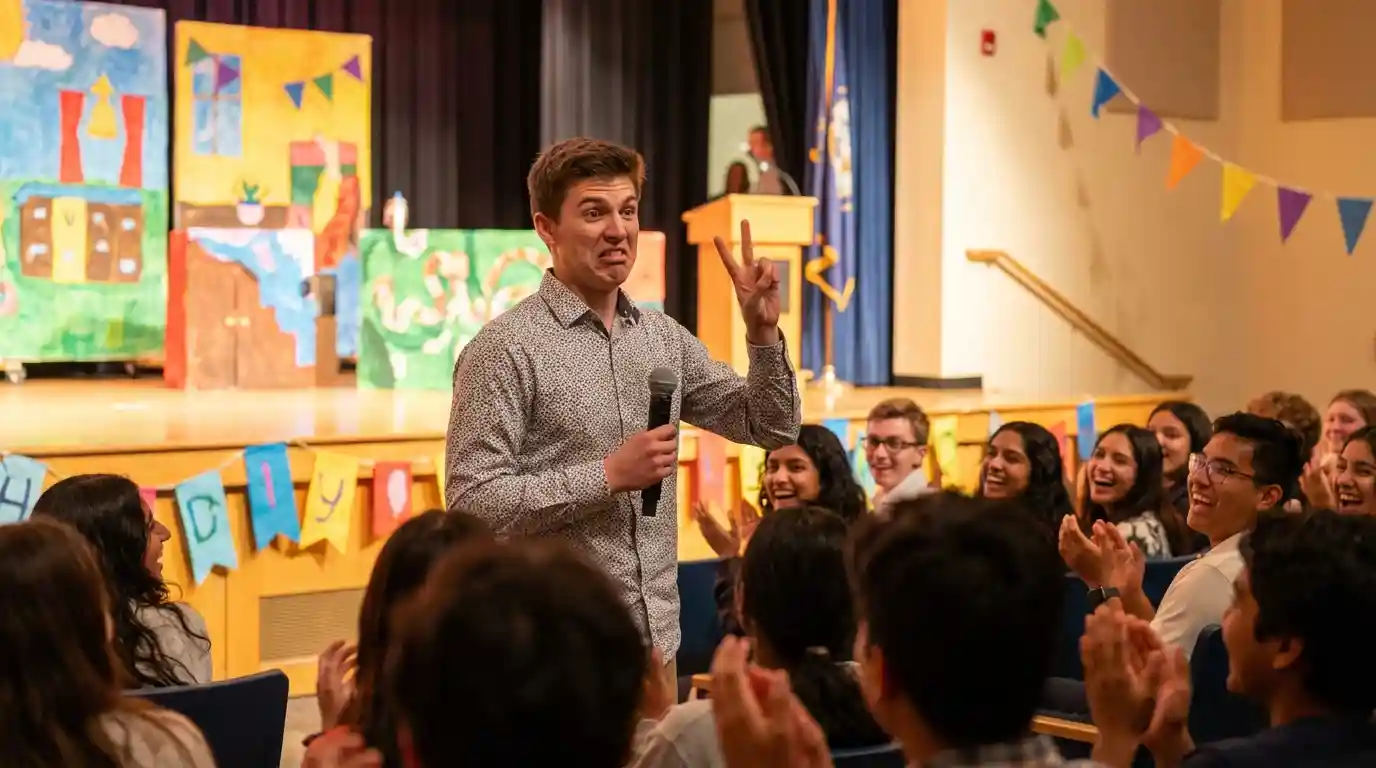
(Scene: The anchor walks on stage. Instead of a formal greeting, they look at their watch and then at the audience with a shocked expression.)
Anchor: “Good morning everyone! Wow, look at those faces. You all look exactly like I did this morning when my alarm went off… half-awake, slightly confused, and wondering why on earth the sun is up so early!”
Anchor: “I know, I know. You’re all thinking, ‘Oh great, another assembly where we stand until our legs give up.’ But don’t worry! Today, I am your anchor, and my goal is to make sure you’re at least 20% more awake by the time you leave.
Let’s start the day with a bit of energy—if you can hear me, clap once! If you can hear me and you’re still sleepy, clap twice! If you can hear me and you’re hungry for lunch already… shout ‘Me too!'”
Also Read: If you’re hosting the very first assembly of a new academic session, this kind of crowd-warming humor becomes even more essential.
We’ve put together a dedicated First Day of School Assembly Anchoring Script 2026 that uses these exact energy-boosting techniques to turn Monday Morning Blues into Monday Morning Magic.
2. Funny Filler Lines (Between Performances)
Use these when there is a delay on stage or a technical glitch:
- The “Technical Glitch” Bit: “It seems our sound system is practicing its ‘Moment of Silence’ a bit too early. While the speakers are having their morning meditation, why don’t we give a round of applause to the technical team who are currently running around backstage like they’re in a Fast & Furious movie?”
- The “Slow Performer” Bit: “Our next performers are just like my internet connection at home—highly talented, but very slow to load. Let’s give them a massive cheer to speed up their entry!”
- The “Principal’s Speech” Tease: “Up next, we have a speech from our Respected Principal. Now, I’ve been told this speech is like a mini-skirt: short enough to be interesting, but long enough to cover the subject!” (Note: Use this only if your Principal has a good sense of humor!)
3. Relatable School/College Jokes
- “Education is important, but school life is like a game of ‘Among Us.’ You’re just trying to finish your tasks before the teacher (the Impostor) catches you doing nothing!”
- “I asked my teacher, ‘Can I be punished for something I didn’t do?’ She said, ‘Of course not!’ I said, ‘Great, because I didn’t do my homework!'”
- “Our school is very modern. We don’t have ‘Backbenchers’ anymore; we have ‘Wireless Knowledge Receivers’ sitting at the back.”
The Director’s Guide: 3 Rules for Comedy Anchoring
1. The “Rule of Three”
Comedy works in threes. Two serious things followed by one funny one.
- Example: “Today we have a dance, a song, and a student who actually finished their assignment on time! (Wait for the laugh).”
2. Don’t Punch Down
The best comedy is “Self-Deprecating” (making fun of yourself) or “Situational” (making fun of school lunch or homework). Never make fun of a student’s appearance or a specific teacher’s personality in a way that feels mean. If you’re going to roast someone, roast the situation, not the person.
3. Timing is Everything
After you say a joke, pause. Give the audience 2-3 seconds to “get it” and laugh. If you keep talking immediately, you will kill the laughter.
Professional comedians call this ‘listening to the room.’ According to Stand-Up Comedy Clinic, great comedic timing isn’t just about when you speak – it’s about how well you listen to your audience’s non-verbal cues in that silence. As an anchor, that 2–3 second pause is your ear to the crowd.
Frequently Asked Questions (FAQs)
Q1: What if nobody laughs at my joke?
Ans: Don’t panic! Use a “Save Line” like: “Well, that joke worked much better in my head this morning!” or “Tough crowd! I guess you all need more coffee.” This usually gets a laugh because it shows you’re comfortable on stage.
Q2: How much comedy should I include in a formal event?
Ans: For formal events, keep the comedy to about 10% of the script. Use it in the opening and as small “one-liners” between segments. Don’t let the jokes overshadow the importance of the event.
Q3: Is it okay to use sarcasm in anchoring?
Ans: Sarcasm is risky. It can come across as rude. Stick to “Relatable Humor”—things that everyone in the school (teachers and students) can agree are funny or difficult.