Convocation Ceremony Anchoring Script: A Complete Hosting Guide
Most anchors treat convocation like every other event on their calendar. Same energy, same pacing, same stock lines.
That’s the mistake.
A convocation isn’t a festival. It’s not an assembly. It’s the one morning in a family’s life where a name gets read out loud and years of sacrifice finally have a stage.
Get that wrong, and nobody remembers the ceremony. They remember the anchor who rushed through it.
1. Why Convocation Hosting Is a Different Skill
Every other school event rewards energy. Convocation punishes it.
Old way: high-pitched, upbeat anchoring that works for Republic Day or Annual Day. New way: composed, warm, unhurried delivery that lets the moment carry itself.
Here’s the test. If your convocation script sounds like your Independence Day script with different words swapped in — you’re doing it wrong.
2. The Three Things That Actually Go Wrong
Not nerves. Not forgetting lines. Three specific failures:
Rushing the name-reading. Two hundred names, tight schedule, anchor panics and starts reading in a flat monotone. Parents miss the one moment they came for.
Guessing designations. Chief Guest, Guest of Honour, Chancellor, Registrar — each title is fixed. Anchors who don’t confirm this in writing beforehand improvise on stage. It reads as disrespect, not confidence.
According to UCLA’s Special Events and Protocol commencement handbook, even seating order, attire, and stage roles at a commencement follow fixed institutional protocol – nothing is left to on-the-spot judgment.
Silence during the gaps. Robe adjustments. Mic handoffs. Photo moments. No bridging lines ready, and the hall goes dead for thirty awkward seconds.
Fix the pacing on names. Confirm every title in writing. Keep two bridging lines in your pocket at all times.
That’s it.
3. The Script Itself
Skip the theory. Here’s what it actually sounds like on stage:
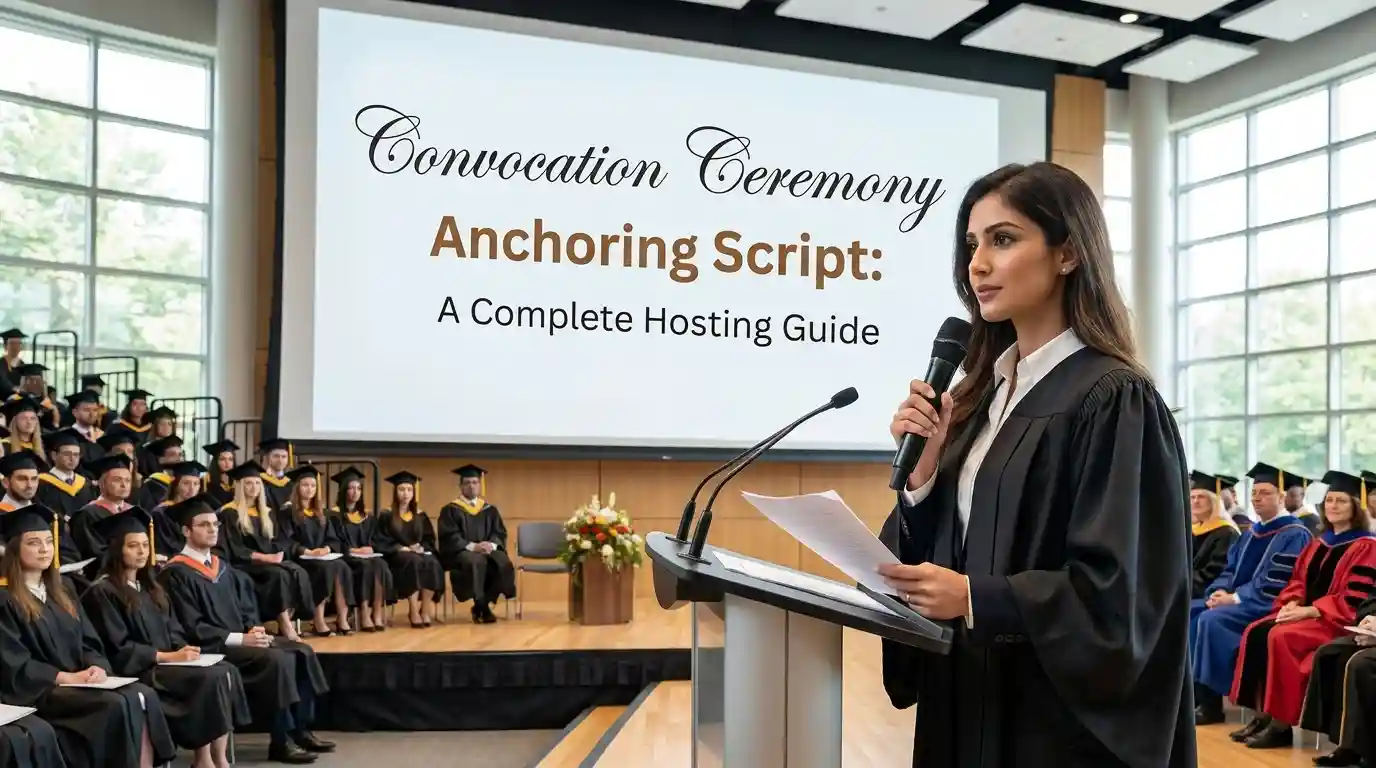
Anchor 1: Good morning, everyone. Before we begin, I want every parent in this hall to know — today’s ceremony is as much a tribute to the years you gave, as it is a celebration of the years your child spent earning this moment.
Anchor 2: We now request everyone to please rise as our academic procession makes its way to the stage.
(Pause for procession music and seating.)
Anchor 1: Please be seated. It is now my honour to invite Dr. Anjali Rao, Chancellor of the institution, to light the ceremonial lamp and formally open today’s convocation.
Anchor 2: We now invite our Chief Guest, Mr. Vikram Sethi, Managing Director of Sethi Industries, to share a few words with our graduating batch. If you need more ways to bring a guest speaker to the podium with the right amount of formality, our collection of guest-invitation anchoring lines has several that work well here too.
(Chief Guest address.)
Anchor 1: We now move to the moment this entire ceremony has been building toward — the conferring of degrees. I request the Registrar to read out the names of the graduating batch, and I’d ask our audience to please hold applause until each row has crossed the stage, so every name can be heard clearly.
(Name-reading and degree conferral.)
Anchor 2: To our graduates still seated and waiting for your row — I know this feels like the longest ten minutes of your academic life. It won’t last much longer.
Anchor 1: That completes the conferral of degrees. Would our graduates please rise, for a very well-earned round of applause.
Anchor 2: We invite Ms. Farah Khan, alumna of the 2019 batch and now Head of Product at a leading firm, to address today’s graduates — someone who sat exactly where you’re sitting, not long ago.
(Alumnus address.)
Anchor 1: On behalf of the institution, thank you to our faculty, and to our parents — without whom none of these graduates would have reached this stage.
Anchor 2: With that, we formally close this convocation. Thank you for making this morning one this institution will remember.
Notice what’s missing. No fake energy. No forced applause lines. The pauses are doing the work.
4. Where Anchors Still Panic – Even With a Script
A script doesn’t save you from live problems. Four of them show up almost every convocation:
A mispronounced name mid-ceremony. Don’t over-apologize on mic — say a quiet “my apologies,” fix it, move forward.
A dignitary running late to the podium. Have a neutral, fact-based filler ready — batch size, department count — not commentary.
Sound cutting out during name-reading. Stop the whole segment. Resume from the last name clearly heard. Don’t continue inaudibly and hope.
Backstage delays during robe adjustments or photos. One reflective line about the significance of the day, held in reserve, stretches thirty to sixty seconds without sounding like filler.
5. Where This Format Falls Short
Honest negative: this script assumes a mid-size batch and a fairly standard dignitary lineup. Bigger convocations — 500+ graduates, multiple guest speakers, staggered department calls — need a modular version, not this exact sequence.
And if your institution runs convocation in a regional language, the tone shifts. Formal English restraint doesn’t map cleanly onto Hindi or Bengali ceremonial register — that’s a different script, not a translation of this one.
Where to Start
Confirm every dignitary’s exact title in writing before the ceremony. Slow your pacing down, especially during name-reading. Keep two bridging lines ready for the gaps nobody plans for.
Convocation doesn’t need a bigger performance. It needs a smaller one, done exactly right.