How to Hide Shaking Hands While Anchoring (Without Anyone Noticing)
Your hands are shaking. The mic is picking it up. Somewhere in row three, someone is watching your fingers, not your face.
This happens to almost every anchor at least once. Not the nervous first-timer only – the confident one too, the one who’s hosted five events before and still felt it on the sixth. Shaking hands aren’t a sign you’re bad at this. They’re a sign your body thinks it’s in danger. It isn’t. But your hands don’t know that yet.
Most anchors try to fix this the wrong way. They grip the mic tighter. They fold their arms. They shove both hands in their pockets and hope for the best. None of it works – and some of it makes the shake more visible, not less.
Here’s what actually works.
1. Why Hands Shake in the First Place
Adrenaline. That’s it. Your body dumps it the second you step under lights with an audience watching, and adrenaline sends extra blood to your muscles – including the small, fine ones in your fingers. Big muscles handle the surge fine. Small ones twitch.
This is why your hands shake but your legs usually don’t. It’s not fear exactly. It’s chemistry.
Knowing this changes how you fix it. You’re not trying to “calm down” in some vague way. You’re trying to give that adrenaline somewhere to go that isn’t your fingertips. If nerves show up well before you even reach the mic, it helps to have a pre-stage routine ready before you’re already on the spot.
2. The Anchors Who Never Look Nervous – What They Actually Do Differently
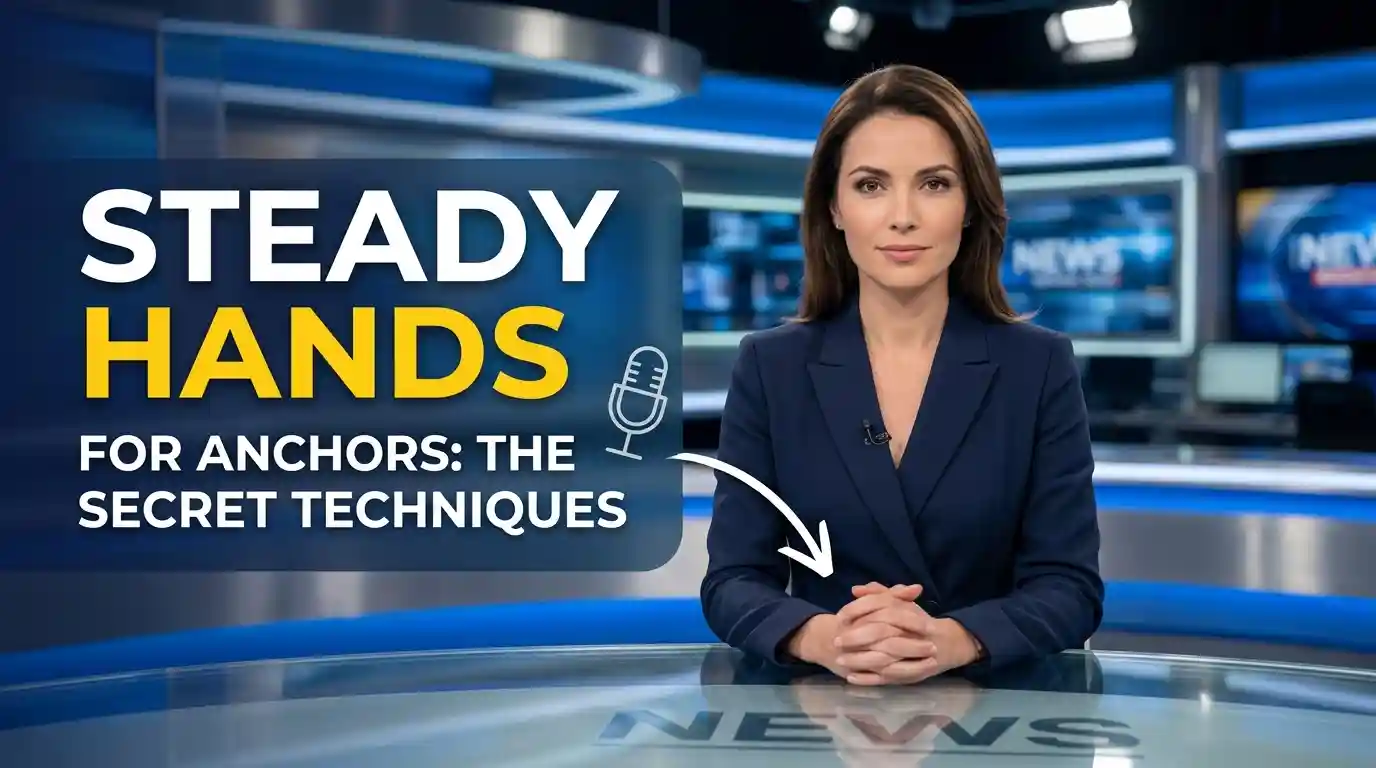
Watch a seasoned anchor closely. Their hands aren’t still because they’re not nervous. Their hands are busy. Busy hands don’t shake – or if they do, nobody can tell.
Old way: hold the mic loosely at chest height, arm floating in the air, nothing anchoring it. Every micro-tremor shows. New way: rest the mic hand against your body – hip, ribcage, folded card – so gravity and contact absorb the shake before it reaches the mic.
Try this the next time you’re on stage. Hold your index cards against your stomach, mic hand resting on top. The shake has nowhere to travel. Gone.
3. Common Mistakes Anchors Make With Shaking Hands
- Holding the mic too far from the body. An outstretched arm has nothing to steady it. Every tremor gets amplified, and the mic itself often shows it through a light rattle on the speaker.
- Clutching the cue card with both hands. Two shaking hands are more visible than one steadied hand. Worse, paper amplifies tremor – a shaking card is loud and obvious even from the back row.
- Standing with hands fully free at the sides. Nothing to rest against means nothing to steady the shake. This is the single biggest mistake beginner anchors make – they think “natural” posture means empty hands. It doesn’t. It means exposed hands. It’s the same instinct that trips people up when they’re walking on stage for the very first time – the body defaults to stiff and exposed instead of anchored.
- Trying to hide hands behind the back. This reads as stiff and robotic, and it does nothing for the shake anyway – you’re just moving the tremor out of sight of the audience, not out of your body.
- Taking a big dramatic breath right before speaking. It looks like exactly what it is – a stress response – and the audience clocks it even if they can’t name it.
4. The Script Moment – Where the Shake Usually Hits Hardest
The worst moment for shaking hands is always the same: right after you’re handed the mic and right before your first line. Here’s how a steady anchor handles that exact transition.
Anchor: (taking the mic, cards resting against the chest, elbow tucked in) Good evening, everyone. What a night this has already turned out to be.
(pause, mic hand steady against the body, other hand resting flat on the card)
I promise you, the next hour has some real surprises waiting.
Notice what’s happening physically in that moment. The mic arm isn’t floating — it’s anchored against the ribs. The free hand isn’t clutching, it’s flat against the card, which stops the paper from amplifying any tremor. And there’s a pause before speaking, not a rushed line — a pause looks confident, not shaky.
5. What to Do If Your Hands Start Shaking Mid-Event
It happens even to prepared anchors — a nervous moment in the middle of a show, not just at the start. Don’t fight it in the open. Set the mic down on the podium stand if one’s available; a stationary mic doesn’t transmit hand tremor at all. No stand? Switch the mic to your dominant hand and use the other to hold your cards flat against your torso — one steady point of contact is enough to kill most of the visible shake.
If you’re mid-sentence and feel it building, slow your pace by half a beat. A slower, deliberate delivery reads as authority, not nerves, and it buys your hands a second to settle.
6. Where This Advice Falls Short
Be honest — no physical trick fixes shaking hands caused by real stage fright that hasn’t been worked through. Resting your hand against your body reduces the visible shake. It doesn’t touch the adrenaline underneath. If your hands shake badly enough that it affects your voice too, or if the fear is bad enough that you’re avoiding anchoring opportunities altogether, that’s a bigger thing than mic grip — that needs actual practice reps in front of small audiences, not a stagecraft trick.
Also worth saying: some of this only works with a handheld mic. Lapel or headset mic users don’t get the “rest the mic hand against the body” trick — for those, cue card placement and breathing pace do almost all the work instead.
Director’s Notes – Delivery and Body Language
Confidence on stage isn’t about feeling calm. It’s about looking settled while your insides do whatever they’re doing. Keep your elbows close to your body – wide, open arm gestures expose tremor, tight ones hide it. Plant your feet shoulder-width apart before you start speaking, not after; shifting your weight mid-sentence reads as fidgety even when your hands are fine.
Breathe from lower in your chest, not the shallow upper-chest breath most nervous anchors default to. Diaphragmatic breathing feeds calmer nerves and a steadier voice at the same time. Shallow breathing feeds the shake. A slower, lower breath before your opening line does more for steady hands than any grip trick.
And remember the pause. Every anchor who looks calm on stage is using pauses on purpose – before the first line, after a laugh line, before a transition. A pause isn’t dead air. It’s you, telling your hands they have time.
That’s the real fix. Not hiding the shake. Managing where it goes.