How to Coordinate with Your Co-Anchor Without Overlapping (2026)
Anchoring an event with a partner is supposed to be fun. You have someone to share the pressure with, someone to bounce jokes off of, and someone to save you if you forget a line.
But if you don’t know how to coordinate with your co-anchor, it can quickly turn into a disaster. You might end up talking over each other, creating awkward dead silences, or looking like two completely separate people who just happen to be standing on the same stage.
If you want to look like a professional TV hosting duo, you need to master the art of “Stage Coordination.” Here is the ultimate guide to sharing the stage perfectly with your partner.
Quick Summary (The Co-Anchor Checklist)
Practicing with your partner right now? Focus on these 4 rules:
- Color-Code the Script: Visually separate your lines from your partner’s lines.
- The “Baton Pass”: Use eye contact to signal the end of your sentence.
- Active Listening: React to your partner’s words; don’t stand like a statue.
- The Rescue Rule: If your partner freezes, jump in and read their line.
🖍️ Step 1: Color-Code the Script (Visual Prep)
When the stage lights are bright and your adrenaline is pumping, it is very easy to accidentally read your partner’s line. To prevent this, your script needs to be visually foolproof.
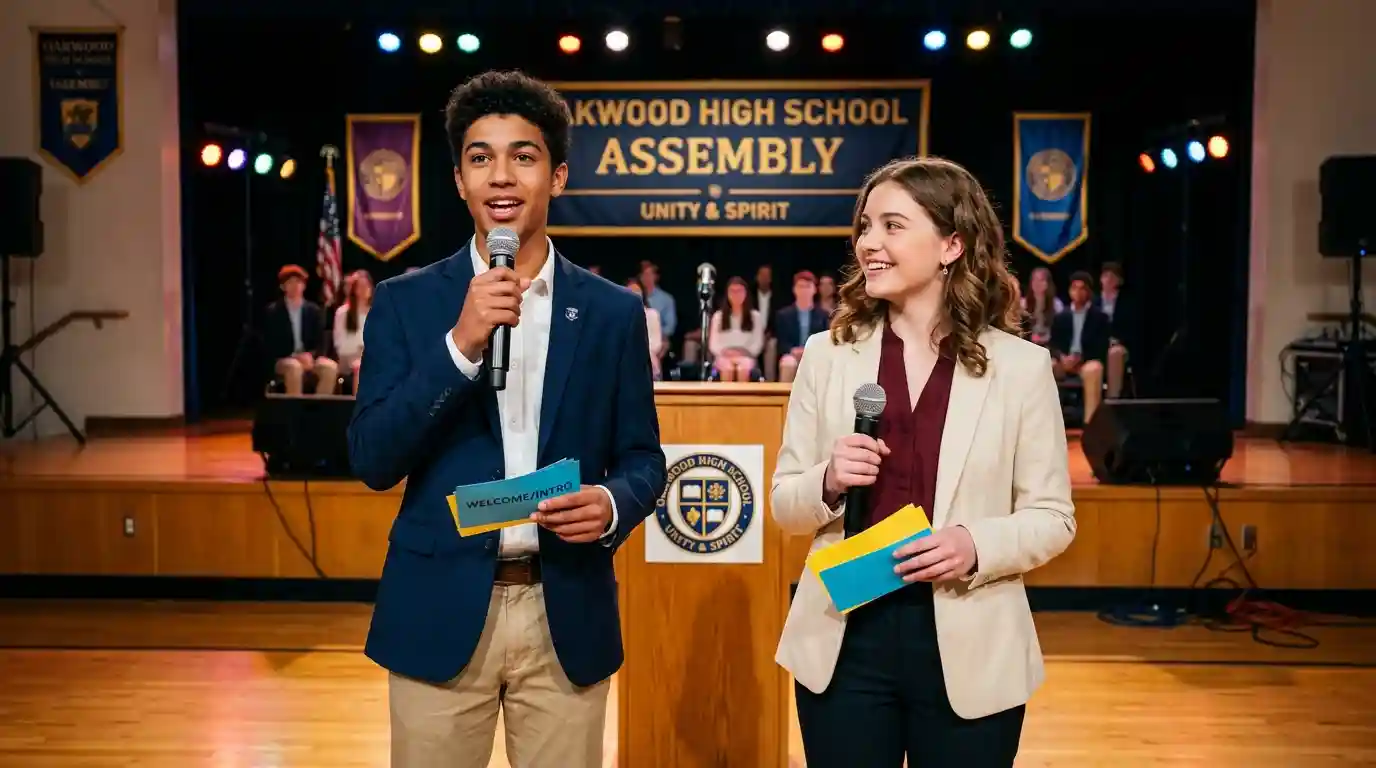
- The Fix: Take two different colored highlighters. Highlight every line for Anchor 1 in Yellow, and every line for Anchor 2 in Blue.
- Why it works: When you look down at your cue card, your brain doesn’t have to read the names “Anchor 1” or “Anchor 2.” You just look for your color. This saves you valuable seconds and completely stops the dreaded “Wait, was that my line or your line?” whisper on stage.
🤝 Step 2: The “Baton Pass” (Eye Contact Transition)
The most awkward moments in co-anchoring happen during the transitions—when one person stops speaking and the other begins. If there is a two-second delay, the energy drops. If you speak too early, you interrupt them.
- The Pro Technique: Treat the conversation like a relay race. When you are reading your final sentence, look at the audience for the first half, but turn your head and look directly at your co-anchor as you say the last three words.
- The Result: This eye contact acts like a “baton pass.” It silently tells your partner, “I am done, it’s your turn.” It creates a seamless, instant transition that looks incredibly professional.
🎭 Step 3: Active Listening (Don’t Be a Statue)
What are you doing when your co-anchor is speaking? Most beginners just drop their microphone, stare blankly into the audience, or nervously look down at their script. This kills the stage chemistry.
- The Rule of Active Listening: When your partner is talking, you must react. Look at them. If they say something exciting, smile and nod. If they tell a joke, laugh at it! This is not just good stage manners — active listening is a well-studied communication skill where the listener’s visible engagement directly confirms to the speaker — and everyone watching — that the message is landing. On stage, that visible engagement is everything.
- The Vibe: The audience mirrors the anchors. If you look bored while your partner is speaking, the audience will be bored too. If you look engaged and supportive, the audience will feel that positive energy.
🛟 Step 4: The Rescue Rule (Having Each Other’s Backs)
Stage panic happens. Even if you practiced a hundred times, your partner might suddenly blank out and forget their line.
- The Wrong Move: Staring at them in silence, waiting for them to remember.
- The Right Move (The Rescue): If there is more than 3 seconds of dead silence and you see panic in your partner’s eyes, you read their line. Do not ask “Are you okay?” on the mic. Just smoothly jump in, deliver the line as if it was yours all along, and keep the show moving. You are a team; if one wins, both win.
🚀 Practice Scenario (The Ping-Pong Drill)
To build chemistry with your co-anchor, try this quick rehearsal drill:
- Stand next to each other holding your color-coded scripts.
- Anchor 1 reads a line to the imaginary audience, turning to look at Anchor 2 on the very last word.
- Anchor 2 must start speaking the exact second Anchor 1 finishes the word.
- Keep passing the lines back and forth like a game of ping-pong. See how fast and smooth you can make the transitions without overlapping!
Ready to Rock the Stage Together?
Now that your stage chemistry is locked in, you need to make sure your technical skills are just as sharp. Make sure both of you read our guide on How to Hold a Microphone Correctly so you sound identical in volume. Need a script designed for two people? Check out our bilingual Farewell Party Anchoring Script for the perfect co-anchor flow.