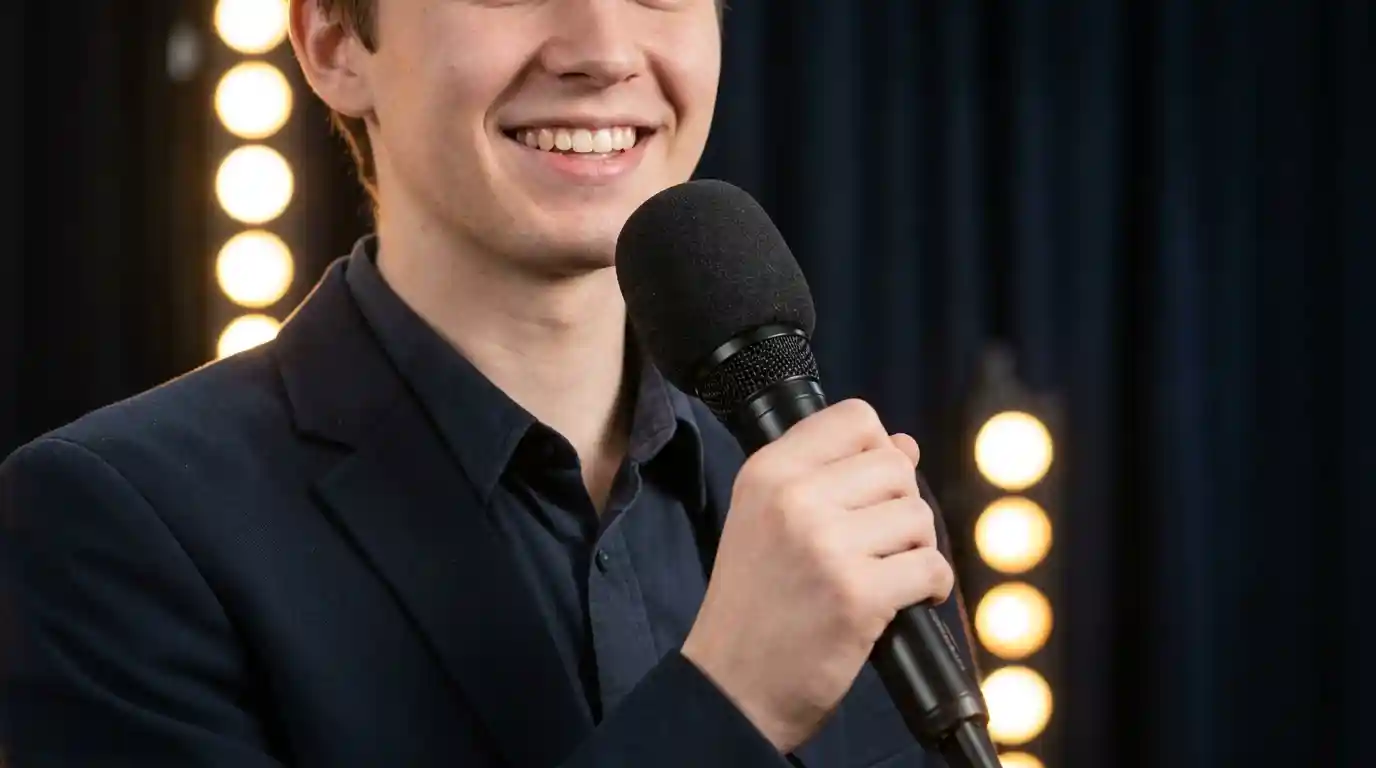
How to Hold a Microphone Correctly During Anchoring (2026)
Picture this: You have memorized your lines perfectly. You walk onto the stage with total confidence.
You open your mouth to deliver your powerful first line, and… SCREECH! A massive, ear-piercing sound echoes through the auditorium. Or worse, you speak, but your voice sounds like you are trapped inside a tin can.
What went wrong? Your script was fine, but your microphone technique was flawed.
Most beginner anchors treat a microphone like a magical wand—they just hold it in the air and hope it works. But a microphone is an instrument. If you want to rank as a top-tier anchor in your school or college, you need to know how to hold a microphone correctly during anchoring.
Here is the ultimate beginner’s guide to mastering stage mechanics.
Quick Summary (The 4 Golden Rules of Mic Technique)
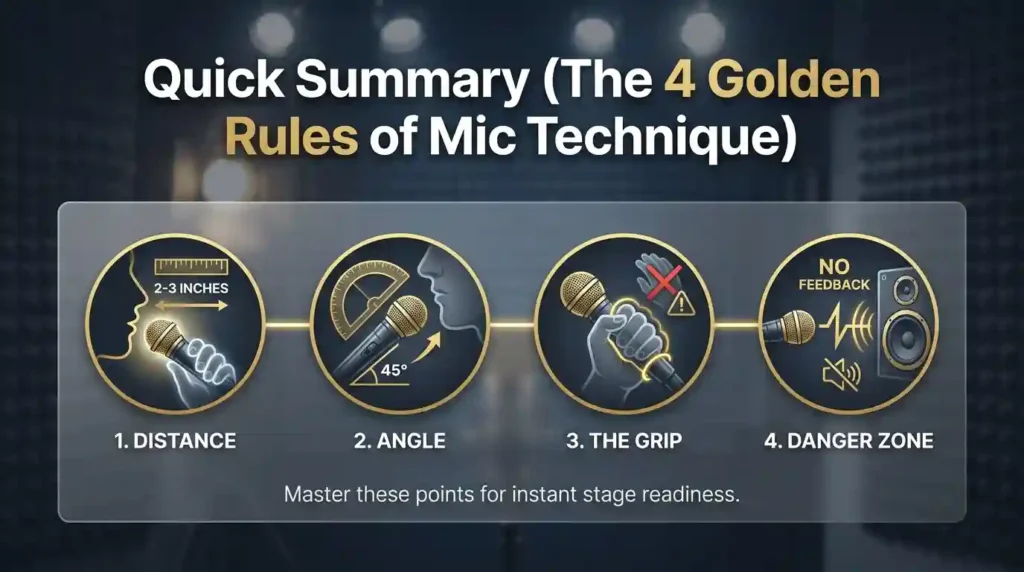
Need to go on stage right now? Memorize these four points:
- Distance: Keep the mic 2 to 3 inches away from your mouth.
- Angle: Hold it at a 45-degree angle pointing at your chin, not covering your face.
- The Grip: Hold the middle of the handle. NEVER cup the top metal grill.
- The Danger Zone: Never point the microphone toward the stage speakers.
🎤 Step 1: The “Chin-Level” Rule (Distance & Angle)
The biggest mistake beginners make is either “eating the mic” (holding it touching their lips) or holding it at their belly button.
- The Sweet Spot: Place the head of the microphone about 2 to 3 inches away from your mouth. (Roughly the width of three fingers).
- The Angle: Do not hold the mic straight up in front of your nose like an ice cream cone. It blocks your face from the audience and catches your heavy breathing. Instead, hold it at a 45-degree angle pointing slightly upward toward your chin. This captures the pure sound of your voice while keeping your face visible.
🚫 Step 2: Avoiding the “Screech” (Feedback)
That horrible, loud ringing sound you sometimes hear at school events is called “Audio Feedback.” As an anchor, it is your job to prevent it. Feedback happens when the sound coming out of the speakers goes back into your microphone.
How to avoid it:
- Never point the mic at a speaker. If you are walking around the stage, be aware of where the floor monitors (the speakers facing you) are. Keep the microphone pointed at your face or the ceiling, never down at the floor monitors.
- Never “Cup” the Mic: You will often see rappers gripping the round metal top of the microphone. Do not do this for anchoring! Cupping the grill blocks the sound escapes, instantly causing a muffled voice and severe feedback. Always hold the microphone by the middle of its handle.
As this guide on microphone tips for public speaking rightly points out, cupping also hides the lower half of your face — and facial expressions are a critical part of your communication with the audience.
Troubleshooting Table
| Problem | Cause | Fix |
|---|---|---|
| Screech sound | Mic facing speaker | Turn away from speaker |
| Low voice | Mic too far | Keep 2–3 inches away |
| Muffled voice | Covering grille | Hold handle, not top |
🔌 Step 3: Cord Management & Posture
If you are not using a wireless microphone, the cord is your biggest enemy. You do not want to trip over it or accidentally unplug it while walking.
- The Loop Technique: Hold the microphone in your dominant hand. Take the cord, create a small loop, and pinch it against the handle with your pinky finger. This ensures that if someone steps on the wire behind you, the mic won’t get yanked out of your hand.
- Keep Your Elbow Relaxed: Don’t lock your arm stiffly against your side. Let your elbow rest naturally near your ribs. If you lock your arm, you will look like a robot on stage.
✋ Step 4: The Smooth “Hand Swap”
If you are anchoring a long event, your arm is going to get tired. You will need to switch hands.
Do not toss the microphone from one hand to the other. Microphones are highly sensitive; hitting your fingers against the plastic casing creates loud “thumps” and “pops” over the speakers.
The Pro Method: Bring your empty hand up to the mic, gently hold the bottom of the handle, and smoothly slide your original hand away. Do this during a pause in your script, not while you are speaking.
🚀 Practice Scenario (The Hairbrush Drill)
You don’t need a real microphone to practice. Go to a mirror right now with a hairbrush or a water bottle:
- Hold the brush 3 inches from your mouth at a 45-degree angle.
- Deliver your opening line.
- Turn your head to look at the “left side” of your audience. Notice: Did your hand move with your head? Pro Tip: Your microphone must always follow your mouth. If you turn your head to look at the Chief Guest, your hand must move the mic with you. Otherwise, your voice will completely fade away!
This happens because most handheld microphones use a cardioid pickup pattern — meaning they capture sound most clearly when pointed directly at the source. This in-depth technical breakdown on mic handling for presentations explains exactly why off-axis positioning kills your sound quality, and is worth a quick read before your next event.
Ready for the Stage?
Now that your audio is going to sound crystal clear, you need the perfect script to match. If you are preparing for your next big event, check out our Best Opening Lines for an Anchoring Script Introduction to start flawlessly, or grab our full College Annual Fest Playbook to practice your new high-energy mic skills!