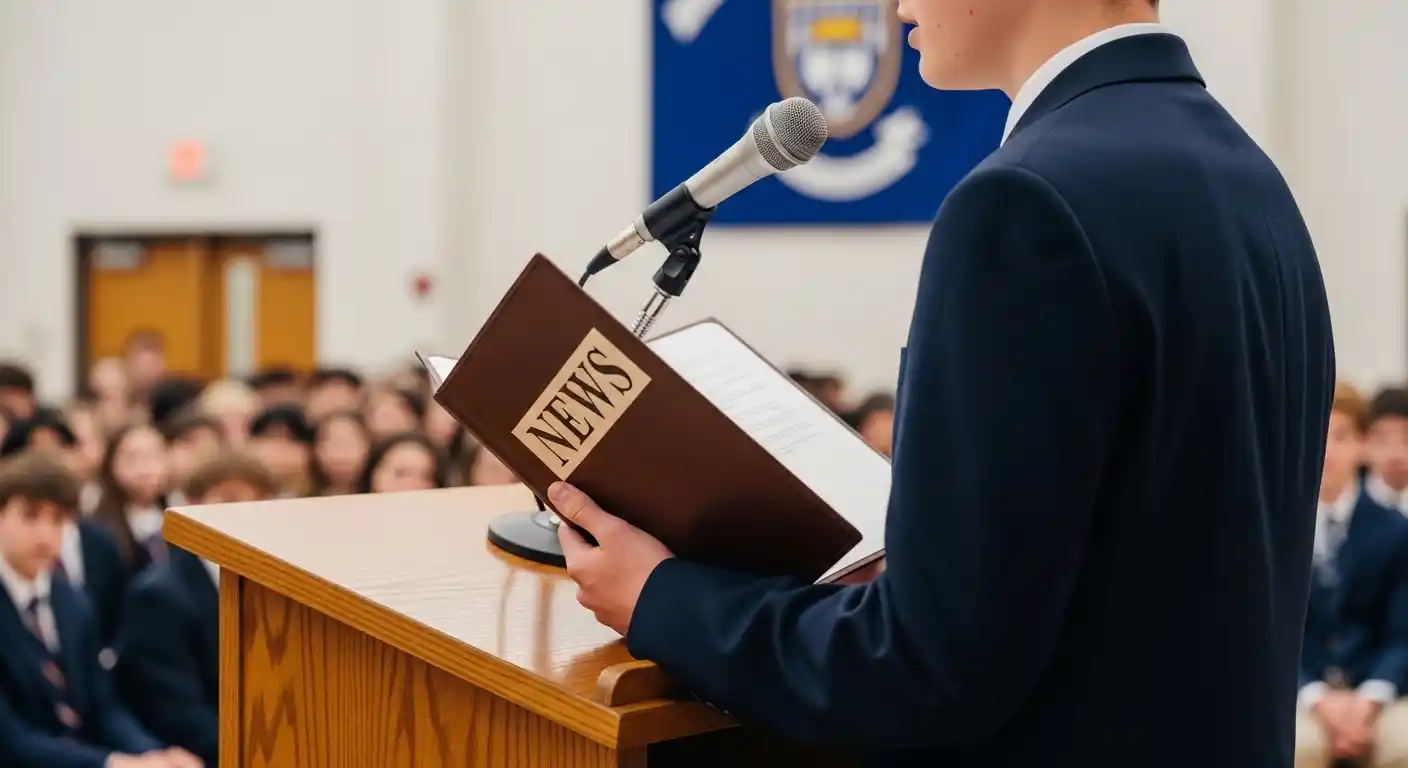
“Updates keep us smart. News keeps us aware.”
Every morning assembly has a “News Reading” segment. If you have been selected as the News Reader for tomorrow, you might be nervous.
Most students make the mistake of just reading the bullet points like a robot.
- Bad Way: “Today’s news is… Modi ji went to USA… Virat Kohli won match…”
- Good Way: “Starting with International updates… shifting our focus to the field of Sports…”
To look professional, you need “Transition Lines” (the words you say between the news).
This article provides a complete News Headlines Anchoring Script with professional Intro, Outro, and Transition lines that will impress your Principal and Teachers.
1. The Professional Intro (Starting Lines)
(Don’t just say “Good Morning.” Start with energy.)
Option A (Formal):
“Good Morning to the Respected Principal, Teachers, and my dear friends.
I am [Your Name] from Class [X].
Here are the news headlines for today, [Date].”
Option B (Creative):
“A very warm Good Morning everyone.
Information is the oil of the 21st century. To keep our engines running, let’s take a look at the happenings around the world.
I am [Your Name] with today’s updates.”
2. Transition Lines (The Secret Sauce)
(Use these lines to move from one category to another smoothy.)
International News (World):
- “Let’s start our journey with updates from around the Globe.”
- “Making headlines Internationally…”
- “First, casting our eyes on the International front…”
National News (India):
- “Now, let’s return to our motherland. Here are the National updates.”
- “Shifting our focus to Home affairs…”
- “What’s buzzing in India today? Let’s find out.”
Sports News (Games):
- “Now, time for some action! Let’s move to the Sports arena.”
- “From the field of cricket to the court of badminton…”
- “For all the sports enthusiasts, here are the latest scores.”
Weather Report:
- “Before we end, let’s check what the sky has in store for us.”
- “Here is the Weather forecast for today.”
3. The Outro (Ending Lines)
(Never stop abruptly. Always sign off properly.)
Option A (Simple):
“That’s all for the news today. Thank you and have a wonderful day ahead.”
Option B (Professional):
“These were the major headlines for this morning.
For more updates, stay curious and keep learning.
This is [Your Name], signing off. Thank you!”
4. Sample Script: Put It All Together
(Example: If you are reading news on a Monday)
“Good Morning everyone.
I am Rahul from Class 9. Here are the news headlines for today, February 16.
Starting with International News:
- NASA has announced a new mission to Mars starting next month.
- The UK Prime Minister is visiting India for trade talks.
Coming to National News:
- The Prime Minister inaugurated the new Vande Bharat Express yesterday.
- CBSE has released the new date sheet for Class 10 board exams.
Moving to the Sports Field:
- India defeated Australia by 6 wickets in the 2nd Test match.
- P.V. Sindhu has entered the finals of the Open Badminton Championship.
Finally, the Weather Update:
- The maximum temperature today will be 28 degrees Celsius with clear skies.
That’s all for today’s news.
Thank you and have a productive day ahead.”
Pro-Tips: How to Read News Like a TV Anchor
1. Eye Contact is Crucial
Don’t bury your face in the paper.
- Technique: Read one line, then look up at the audience for 2 seconds. According to public speaking experts at Toastmasters International, maintaining eye contact builds instant trust with your listeners
2. Voice Modulation
- Serious News (War/Accident): Keep your voice low and slow.
- Sports News (Winning): Keep your voice high, fast, and energetic.
3. The Folder Trick
Always hold a Folder or Clipboard. Holding a loose fluttering paper looks messy and nervous. A folder makes you look like a professional journalist.
Frequently Asked Questions (FAQs)
Q1: How many news headlines should I read?
Ans: Ideally, pick 4 to 6 headlines.
- 1-2 International
- 2-3 National
- 1 Sports
If you read too many, students will get bored and stop listening.
Q2: Can I read news from my mobile phone?
Ans: Avoid it. Most schools consider it informal or disrespectful to look at a phone on stage. Always print it out or write it neatly on an A4 sheet.
Q3: What if I pronounce a difficult name wrong?
Ans: Don’t panic. Just say “Correction” and say it again properly. Even professional news anchors make mistakes.
Note: After reading the news, the next step is usually the Thought. Check our 15+ Thought of the Day Collection to be ready.”
