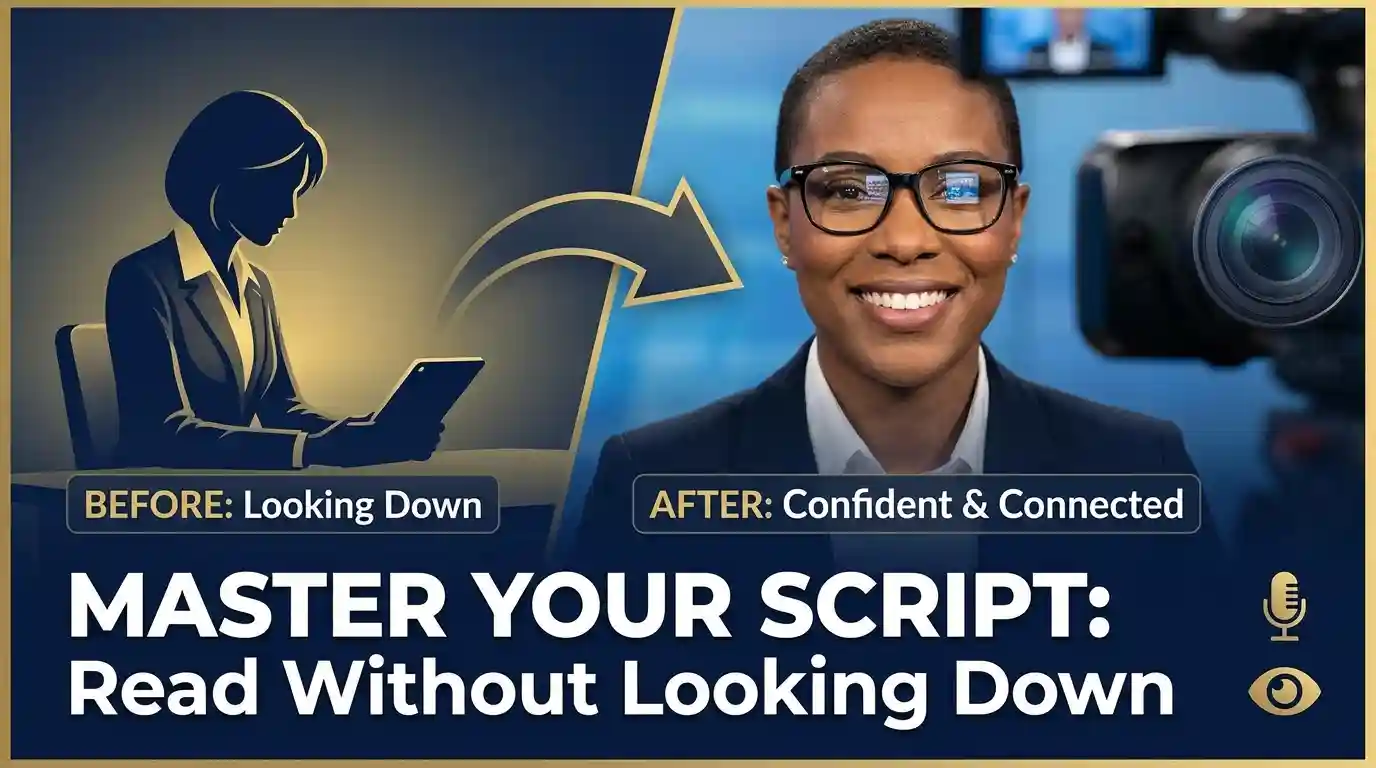
We have all seen it happen. An anchor walks onto the stage, says “Good Morning,” and then instantly drops their head, staring at a shaking piece of A4 paper for the next ten minutes.
They read beautifully, but because they never look up, the audience completely loses interest and starts checking their phones.
If you are preparing for a school or college event and wondering how to read your anchoring script without looking down, you are in the right place.
You don’t need a photographic memory to look like a professional. You just need a few mechanical stage tricks.
Here is the ultimate guide to maintaining perfect eye contact while keeping your script as your safety net.
Quick Summary (The Eye-Contact Formula)
Short on time? Memorize these 4 rules before you go on stage:
- Ditch the A4 Paper: Use small, stiff cue cards instead.
- The 80/20 Rule: Look at the audience 80% of the time, and your cards 20%.
- The Thumb Slide: Use your thumb to physically track your lines.
- Format for the Glance: Use big fonts and bold the first word of every sentence.
🚫 Step 1: Ditch the Floppy A4 Paper
The biggest mistake beginners make is printing their script on standard A4 printer paper.
- Why it’s bad: Thin paper shakes when your hands tremble (showing the audience you are nervous). It reflects the harsh stage lights into your eyes, and because it is so large, you have to tilt your entire head down to read the bottom of the page.
- The Fix: Cut a piece of thick chart paper or cardboard into A5-sized Cue Cards (half the size of normal paper). Hold them high at chest level. Now, to look at your script, you only have to lower your eyes, not your whole head!
👀 Step 2: The “80/20” Delivery Rule
You do not need to memorize your entire script, but you must memorize the structure of your sentences. This is where the 80/20 Rule comes in.
- 20% (The Glance): Look down at your cue card for exactly one second. Grab the first 3 or 4 words of the sentence in your mind.
- 80% (The Delivery): Immediately look up, lock eyes with someone in the audience, and deliver the rest of the sentence while looking directly at them.
Example: (Look down at card) “Our next performance is…” (Look up at audience) “…a tribute to the brave soldiers of our country. Please welcome the Red House!” You only need the card to trigger your memory, your natural speaking voice will finish the thought.
👍 Step 3: The “Thumb Slide” Trick
The scariest part of looking up at the audience is the fear that when you look back down, you will lose your place and stare in awkward silence.
The Pro Solution: Hold your cue card with one hand. Place your thumb flat against the edge of the card, pointing directly at the line you are currently reading. As you speak, slowly slide your thumb down the side of the card.
Whenever you look up at the audience and look back down, your eyes will instantly snap to where your thumb is resting. You will never lose your place again.
🖨️ Step 4: The “Glance-Friendly” Format
How your script is typed is just as important as how it is read. If your script looks like a dense textbook paragraph, your eyes will get lost. Format your script specifically for the stage:
- Huge Font: Use size 14 or 16 Arial or Calibri.
- Double Spacing: Leave a wide gap between every line so they don’t blur together.
- Bold the Triggers: Bold the first word of every new paragraph or introduction.
- One Thought Per Card: Never print a sentence that starts on the bottom of one card and ends on the top of the next. When the performance is over, you flip the card.
There is solid science behind this advice. Research cited by the Nielsen Norman Group, based on an MIT study, confirms that for glanceable reading — where you need to grab information in one quick look — larger font sizes, regular (non-condensed) widths, and bolder formatting all significantly improve how fast the eye identifies words.
In other words, when you format your cue card like a stage script rather than a typed document, you are literally engineering it to be read faster under pressure.
🚀 Practice Scenario (The News Anchor Drill)
Want to master this before your event? Try this quick exercise at home:
- Turn on the TV to a news channel (mute the volume).
- Hold your script at chest level.
- Look down, grab a sentence, and then look up at the news anchor on the TV.
- Deliver the sentence directly to the person on the screen without breaking eye contact.
- Slide your thumb, look down for the next sentence, and repeat!
Ready to Own the Stage?
Now that you know how to hold the audience’s attention with perfect eye contact, you need to make sure your voice sounds just as good!
Make sure to read our highly popular guide on How to Hold a Microphone Correctly so you don’t cause any stage feedback. If you need a script to practice with, check out our 15 Best Opening Lines for Anchoring.