Best Diwali Anchoring Script for School Assembly (Eco-Friendly & Cultural Theme)
Why Standard Diwali Assembly Scripts Lose the Crowd
Every November, school assembly anchors walk up to the podium and recite the exact same textbook lines: “Diwali is the festival of lights. It marks the return of Lord Rama to Ayodhya after 14 years of exile.”
Within thirty seconds, the younger classes start whispering and the senior rows tune out. They already know the history. What a morning assembly actually needs is the warm, festive atmosphere of Diwali brought to life through the microphone.
A great school Diwali assembly balances three things: traditional reverence during the lamp lighting, high energy during cultural performances, and a practical message about celebrating safely and supporting local artisans.
This guide gives you a complete, word-for-word dual-anchor script in a natural English and Hindi (Hinglish) flow, along with stage-management cues for handling live diyas, choir transitions, and assembly pledges.
Pre-Assembly Stage Checklist for Anchors
Before the first bell rings, both anchors should verify these four details backstage with the teacher-in-charge:
- Turn Off the Stage Ceiling Fans: The number one cause of awkward delays during a Diwali assembly is the ceremonial lamp (diya) refusing to stay lit because the overhead stage fan is running at full speed. Ask the stage manager to switch off the front fans 5 minutes before Deep Prajwalan.
- Keep Extra Matchboxes and a Candle Ready: Never rely on a single lighter on the brass tray. Keep one small lit candle sheltered behind the podium so the Chief Guest or Principal can light the wick in seconds.
- Coordinate Your Dress Code: If your school allows traditional attire for the anchors, coordinate colors in advance so you complement each other on stage rather than clashing.
- Mark Your Cue Cards: Use Anchor 1 for crisp English transitions and Anchor 2 for warm Hindi lines and Shayari.
If you are new to the mic, read up on the proper technique for anchoring first. Pacing, pauses and eye contact are what stop cue cards from sounding like they are being read aloud.
Complete Diwali Anchoring Script (Anchor 1 & Anchor 2)
Segment 1: The Festive Opening Hook
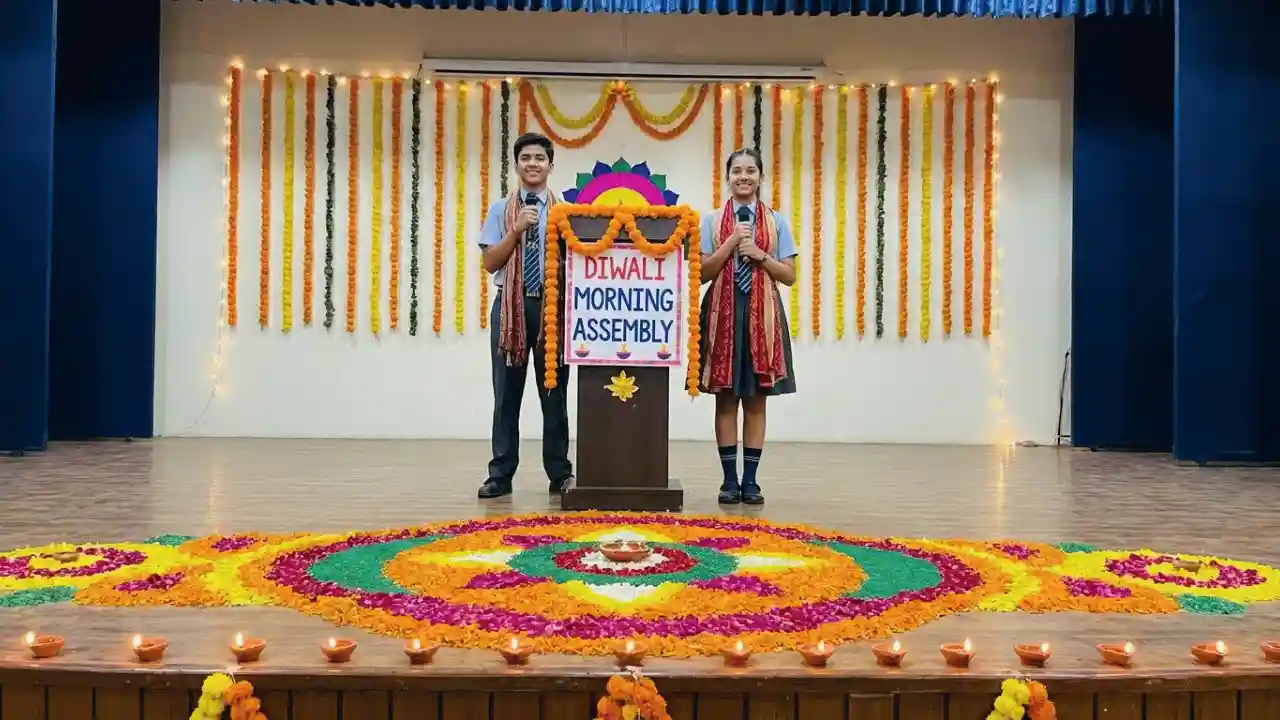
(Both anchors walk to the center microphone with a warm smile. Wait 2 seconds for the morning assembly lines to settle.)
Anchor 1: Good morning to our Respected Principal, dedicated teachers, and my dear friends. When you walked through the school gates this morning, you probably noticed something different—the marigold flowers at the entrance, the bright rangoli in the corridor, and a little extra excitement in the air.
Anchor 2: Bilkul sahi kaha! Kyunki saal ka sabse roshan aur khushiyon bhara tyohar hamare darwaze par dastak de chuka hai.
“Andhere par ujaale ki jeet ka prateek hai Diwali,
Har chehre par muskaan aur har ghar ki raunak hai Diwali,
Sirf mitti ke diyon ko hi nahi,
Dilon ko bhi roshan karne ka tyohar hai Diwali!”
Anchor 1: A very warm welcome to our special pre-Diwali morning assembly! Today, we are not just celebrating a date on the calendar; we are celebrating the light of knowledge, kindness, and togetherness.
Segment 2: Ceremonial Lamp Lighting (Deep Prajwalan)
Anchor 1: Since Diwali is the festival of light, there is no better way to begin our program than by kindling the ceremonial lamp—a symbol of removing ignorance and welcoming wisdom into our school.
Anchor 2: Shastro mein kaha gaya hai – Tamaso Ma Jyotirgamaya – yaani andhakar se prakash ki aur chalo. Main hamare aadaraniya Principal Sir/Ma’am aur senior teachers se vinamra nivedan karta/karti hoon ki woh manch par aayein aur Deep Prajwalan kar aaj ke karyakram ka shubharambh karein.
Stage note: Tamaso Ma Jyotirgamaya is part of the Pavamana Mantra from the Brihadaranyaka Upanishad, and it means “lead me from darkness to light.” If a teacher asks about the line, you can explain it in one sentence.
(As the Principal steps forward, Anchor 1 signals the school choir to begin a soft instrumental or shloka.)
Anchor 1: (Speaking softly while the lamp is being lit) As each wick catches flame, notice how a single small diya has the power to push back the darkness without making a sound. May this light guide our thoughts and actions throughout the year. Thank you, Sir/Ma’am, for gracing the stage.
Segment 3: Introducing the Mythological Skit or Ramayana Act
Anchor 2: Doston, Diwali ki kahani hum sab ne bachpan se suni hai – Maryada Purushottam Shri Ram ka चौदह (14) varsh ke vanvas ke baad Ayodhya lautna. Lekin kya humne kabhi socha hai ki Shri Ram ke jeevan se aaj ke students kya seekh sakte hain?
Anchor 1: Patience under pressure, respect for parents, and standing up for what is right – even when it is difficult. To bring those timeless values alive on our stage today, the students of Class 8th B (swap with your performing class) have prepared a short dramatic presentation. Let us welcome them with a huge round of applause!
(Anchors step back to the side podium while the skit takes place.)
Segment 4: Introducing the Classical / Festival Dance Performance
(Once the skit actors take their bow and begin exiting the stage, Anchor 1 steps up immediately to keep the energy moving.)
Anchor 1: What a powerful performance! Give another big hand to Class 8th B for reminding us what true character looks like.
Anchor 2: Aur ab baari hai us pal ki jiske bina har Bhartiya tyohar adhura lagta hai – संगीत aur नृत्य! Jab ghar-ghar mein diyon ki katar sajti hai, toh khushi apne aap kadmo mein aa jaati hai.
Anchor 1: Combining traditional grace with festive rhythm, here come the talented dancers of Class 7th A to fill this auditorium with color and celebration. Put your hands together!
Segment 5: The “Green & Vocal for Local” Diwali Pledge
Anchor 1: That dance truly brought the spirit of Diwali onto our stage! Before we invite our Principal for the holiday message, let us take 60 seconds to talk about how we celebrate outside these school walls.
Anchor 2: Har saal Diwali se pehle sadak ke kinare mitti ke diye bechne wale kumhaar (potters) badi umeed se hamara intezar karte hain. Unke haath se bane mitti ke diye kharidna sirf ek shopping nahi, balki kisi ke ghar mein asli Diwali manane ka zariya hai.
Anchor 1: At the same time, real celebration never comes at the cost of our environment, our pets, or our elderly neighbors. I request every student in the assembly today to raise your right hand for a quick, three-point School Diwali Pledge. Repeat after me:
- All Students: “This Diwali, we will light clay diyas and support local artisans in our neighborhood.”
- All Students: “We will celebrate a clean, low-smoke, and safe Diwali that respects nature, animals, and elders.”
- All Students: “We will share sweets, kindness, and joy with those who need it most.”
Anchor 1: Thank you, everyone. You may lower your hands.
Segment 6: Principal’s Address & Vote of Thanks
Anchor 1: Now, to share their festive blessings and guide us before we head into the Diwali break, I invite our Respected Principal Sir/Ma’am to address the assembly.
(After the Principal’s speech)
Anchor 2: Bahut-bahut dhanyawad Sir/Ma’am. Aapke shabd hamesha humein behtar insaan banne ki prerna dete hain.
Anchor 1: Before we disperse to our classrooms, a special thank you to our music teachers, the stage decoration team who created today’s rangoli, the sound crew, and all our performers.
Anchor 2: Jaate-jaate humari taraf se aap sabhi ko aur aapke poore parivar ko:
“Diyon ki roshni se jhilmilata aangan ho,
Rishton mein mithaas aur khushiyon ka saawan ho,
Aap sabhi ko ScriptWala parivar aur hamare school ki aur se,
Ek surakshit aur shubh Deepavali mubarak ho!”
Both Anchors: Wishing you all a very Happy and Safe Diwali! Thank you, and have a wonderful day ahead!
Stage Troubleshooting Guide for Diwali Anchors
Live school events rarely go 100% according to plan. Use this quick reference table if you run into a delay on stage:
| Stage Situation | What the Anchor Should Do & Say |
| The ceremonial diya takes too long to light | Do not stand in awkward silence. Keep speaking calmly: “As our guests light each wick on the ceremonial lamp, let us take a quiet moment to reflect on our goals for the upcoming term.” |
| Dance audio track does not play immediately | Smile at the audience and fill the 15-second gap: “While our sound desk cues up the festive beats, let me see which row is the most excited for the Diwali holidays – give me a quiet wave!” |
| Skit props or chairs are still being cleared | Acknowledge the crew positively: “A big thank you to our backstage volunteers who work quietly behind the scenes to set up every performance.” |
Frequently Asked Questions (FAQs)
Q1: How long does this Diwali assembly script take to perform?
Ans: The anchoring lines take roughly 5 to 6 minutes in total. When combined with a 5-minute skit, a 4-minute dance performance, Lamp Lighting, and the Principal’s speech, the entire assembly fits comfortably into a 20-to-25-minute morning slot.
Q2: Can a single anchor perform this script alone?
Ans: Yes. If you are hosting solo, simply merge Anchor 1 and Anchor 2’s lines. Start each segment in English for the formal announcement and use the Hindi Shayari as your emotional highlight before calling the next performance.
Q3: How can we make the assembly interactive for primary school kids?
Ans: Before the skit begins, ask two quick festival trivia questions from the podium – such as asking the junior rows which traditional sweet is their favorite or why clay diyas are used – to keep the youngest students attentive.