Best Anchoring Script for Debate Competition (2026 Protocol)
“A debate is not a shouting match; it is a battle of intellect, logic, and persuasion.”
Hosting a debate competition is completely different from hosting a dance show or an annual day. You cannot use high-energy, casual lines. You are not a hype-man today; you are a moderator.
In a debate, the anchor holds the entire structure of the event together. If you mess up the introduction of the topic (the motion), fail to explain the time limits clearly, or show bias toward one team, the entire competition loses its credibility.
That pressure is exactly why so many first-time anchors freeze up before a debate round — if nerves are your bigger concern right now, it helps to sort that out first with these steps to calm stage fright before anchoring.
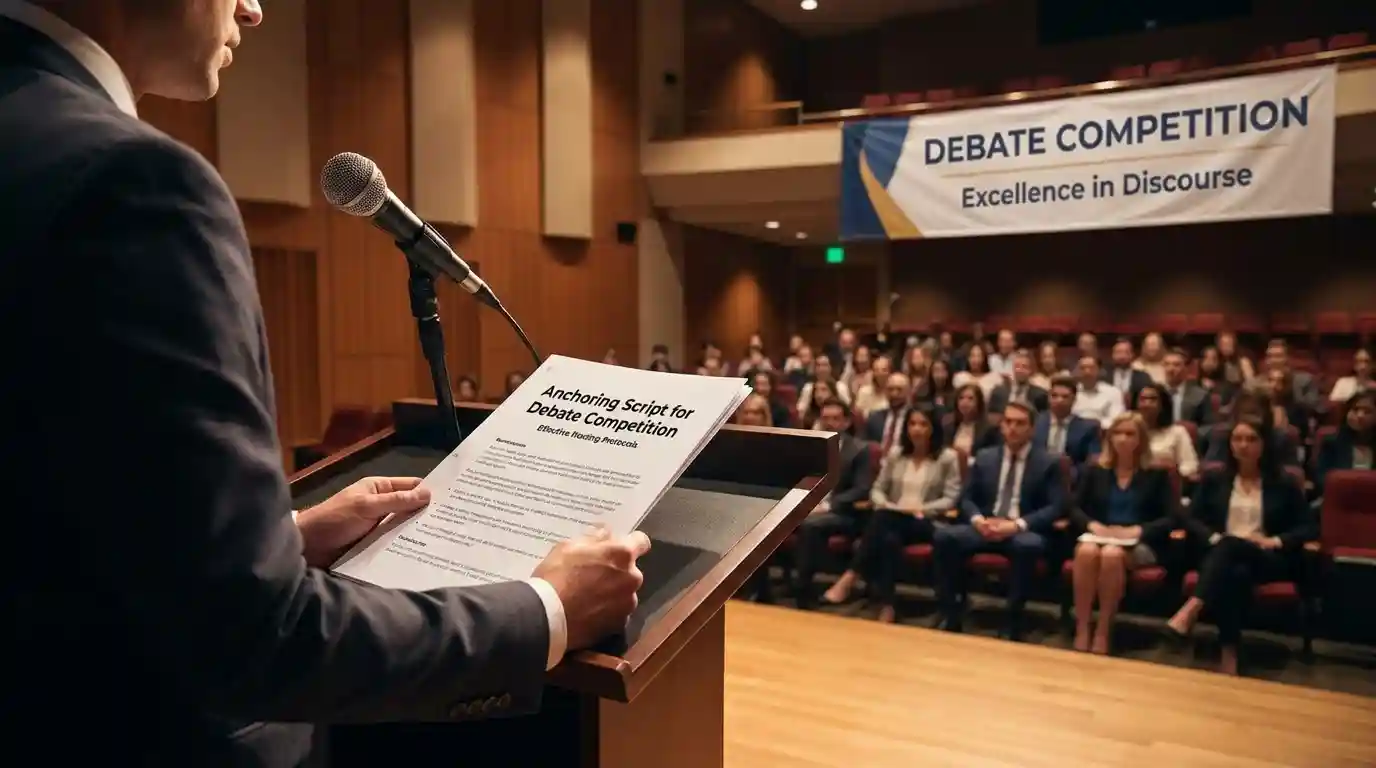
If you want to sound sharp, authoritative, and incredibly professional, you need a strict, protocol-driven anchoring script for a debate competition. Here is the ultimate 2026 playbook for moderating an intellectual battlefield.
⚖️ Phase 1: The Intellectual Welcome & The Motion
Start with a heavy, thought-provoking quote. Immediately establish what the debate is about so the audience is hooked from the first minute.
Anchor 1: “It is better to debate a question without settling it, than to settle a question without debating it. A very good morning to our esteemed Principal, our learned teachers, and my fellow students.”
Anchor 2: “Welcome to the [Year] Inter-House Debate Competition. Today, we are not here to agree with each other. We are here to challenge ideas, expose logical flaws, and witness the power of a well-constructed argument.”
Anchor 1: “The motion for today’s debate – the topic that will divide this room into two fierce sides—is: ‘[Insert The Debate Topic Here, e.g., Artificial Intelligence is a Threat to Human Creativity]’.”
Anchor 2: “We have teams ready to defend this motion, and teams ready to tear it apart. But before the verbal war begins, we must introduce the commanders of this courtroom.”
👨⚖️ Phase 2: Introducing the Jury (The Judges)
Debate judges are usually highly intellectual guests. Introduce them with immense respect, focusing on their analytical skills.
Anchor 1: “To judge a battle of wits, we need minds of exceptional caliber. It is my profound privilege to introduce our distinguished panel of jury members for today.”
Anchor 2: “Please welcome [Judge 1 Name], who brings with them [Mention 1 achievement, e.g., 10 years of experience in literature and public speaking]. We are honored to have you, Sir/Ma’am.”
Anchor 1: “Joining them is [Judge 2 Name], known for their incredible analytical skills and [Mention achievement]. Thank you for gracing us with your presence today.”
⏱️ Phase 3: Laying Down the Rules (The Protocol)
You must state the rules clearly on the microphone so that the audience, the speakers, and the judges are all on the same page.
Anchor 2: “Before I call the first speaker, let me clearly state the rules of engagement for today’s debate.”
Anchor 1: “1. Each speaker will be given exactly [Number] minutes to present their arguments. 2. A single warning bell will ring at [Number] minutes. 3. A double bell will ring at the final mark, after which the speaker must immediately step down. 4. The judging criteria will be based on content, delivery, logic, and rebuttal. No personal attacks will be tolerated.”
For a deeper look at how judges actually weigh these factors round to round, Debating For Everyone’s guide on judging a debate breaks it down well.
🎙️ Phase 4: Calling the Speakers (Proposition & Opposition)
Use a neutral, professional tone when transitioning between speakers. Never comment on whether an argument was “good” or “bad.”
Anchor 2: “The rules are set. The judges are ready. Let us begin. I invite the first speaker from the Proposition (For the motion), representing [House/School Name], to open the debate.”
(After the first speaker finishes)
Anchor 1: “A strong opening statement. But every coin has two sides. To counter those arguments, I now invite the first speaker from the Opposition (Against the motion), representing [House/School Name].”
(Use these neutral filler lines between the remaining speakers):
- “Thank you for that perspective. Moving forward, I invite the next speaker for the proposition…”
- “A very passionate argument indeed. Let us see how the opposition responds to that…”
🏆 Phase 5: The Conclusion & Results
After all speakers have finished, shift the focus back to the judges for the final verdict.
Anchor 1: “And with that, the battle of words comes to an end. We have heard brilliant statistics, fierce rebuttals, and undeniable logic from both sides.”
Anchor 2: “While our esteemed judges compile the final score sheets, let us give a massive round of applause to every single debater who had the courage to step up to this podium today.”
Anchor 1: “I now request our Head Jury Member to please come to the stage, share their observations on today’s debate, and announce the final results.”
(After the results are announced)
Anchor 2: “Congratulations to the winners, and a huge respect to the runners-up. You gave us a lot to think about today. This is [Your Name] and [Partner’s Name], officially closing the debate. Have a wonderful and thoughtful day ahead!”
The Anchor’s Cheat Sheet: The Rule of Neutrality
The biggest mistake a debate anchor can make is showing bias. If a speaker makes a brilliant point, do not say: “Wow, what an amazing point, I completely agree!” Your job is to remain 100% neutral. Simply say,
“Thank you for your thoughts,” and call the next speaker. If you take sides, the opposite team can officially complain that the moderator was biased. Be the referee, not the player!
And if staying composed and neutral on stage doesn’t come naturally yet, this guide on introducing yourself confidently on stage is a good place to build that calm, controlled tone before your next round.