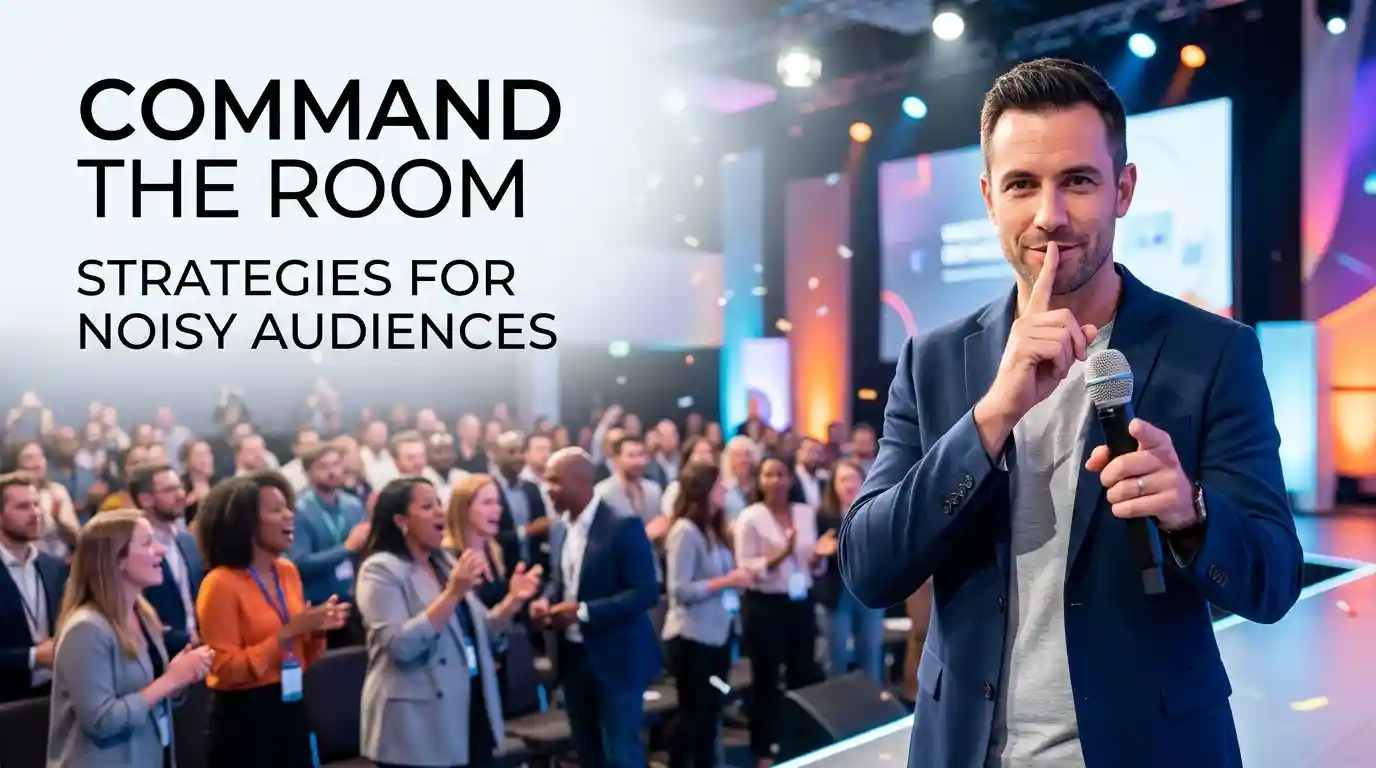
How to Silence a Noisy Audience Before Anchoring (2026 Tips)
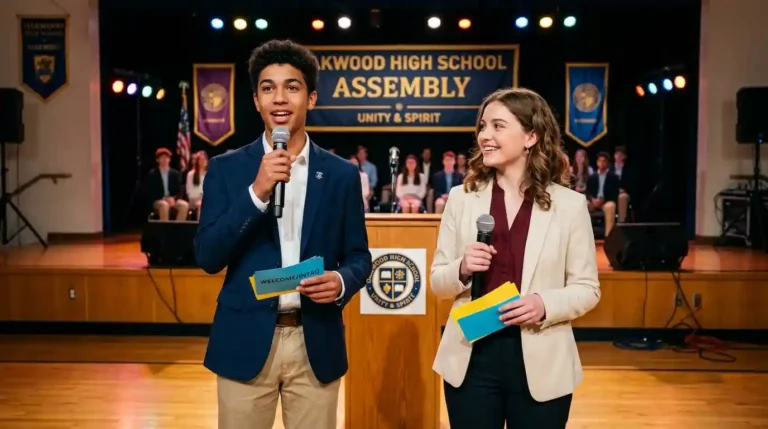
You have memorized your script perfectly. You know exactly how to hold your microphone. You walk onto the stage, ready to deliver an epic opening line… but there is a massive problem. The audience is talking, laughing, and completely ignoring you.
As a student anchor, this is one of the most terrifying moments. Your first instinct is to lean into the microphone and shout, “Hello! Excuse me! Pin drop silence please!” Do not do this.
The moment you scold the audience, you stop being an engaging anchor and start sounding like a strict teacher. You lose their respect and their excitement instantly.
If you are wondering how to control an audience during anchoring without losing your cool factor, you need to use psychological stage mechanics. Here is the ultimate guide to grabbing the crowd’s attention like a seasoned professional.
Quick Summary (The Crowd Control Checklist)
Audience too loud right now? Use these 4 steps:
- The Power Pause: Stand completely still and say nothing.
- The “Call and Response” Trick: Use clapping to break the noise.
- The “Low Volume” Drop: Speak softly to force them to listen.
- Praise the Quiet: Thank the people who are already listening.
Ready-to-Use Crowd-Control Lines
- “If you can hear me, clap once.”
- “Red House looks ready; Blue House, are you with us?”
- “Let’s take five seconds of silence before we begin.”
🛑 Step 1: The “Power Pause” (The Silent Stare)
The most powerful tool an anchor has is silence. When the audience is noisy, they expect you to try and talk over them. When you don’t, it confuses them.
- The Technique: Walk to the center of the stage, look directly into the crowd, put a pleasant (but firm) smile on your face, and say absolutely nothing. * Why it works: The people in the front row will notice you waiting. They will nudge their friends and say, “Shh, they are starting.” Like a domino effect, the silence will ripple to the back of the room. It usually takes about 5 to 10 seconds. Stand your ground. Do not speak until you have their attention.
This is not just a stage trick — it is a well-documented communication technique. Toastmasters International, in their guide on the surprising benefits of the pause, explains that when a speaker goes silent, the audience’s own curiosity does the work — they stop talking to find out what is happening.
👏 Step 2: The “Call and Response” Trick
If the crowd is extremely large (like at a college fest or a sports day) and the Power Pause isn’t working, you need to interrupt their conversations with an action.
- The Technique: Lean into the mic and say in a bright, energetic voice: “If you can hear my voice, clap once!” (A few people will clap). Then say, “If you can hear my voice, clap twice!” (More people will clap).
- Why it works: It forces the audience to stop talking so they can participate in the action. By the time you say, “If you are ready to begin, give me a huge round of applause!”, the entire room is looking at you, cheering, and the side-conversations are completely dead.
🤫 Step 3: The “Low Volume” Drop
It sounds completely backward, but if a room is noisy, do not speak louder. If you shout, the audience will just talk louder to hear each other over your voice.
- The Technique: Start your first sentence at a slightly lower volume than normal.
- Why it works: Human curiosity is powerful. When people see you speaking on stage but can’t quite hear what you are saying, they will naturally stop talking to listen. Once the room drops to a hush to hear you, you can smoothly raise your voice back to your normal, confident anchoring volume.
🎯 Step 4: Praise the Quiet
Psychologically, people respond much better to positive reinforcement than to being scolded. Instead of pointing out the people who are making noise, highlight the people who are behaving well.
- The Technique: Speak directly to a section of the audience that is paying attention. Say, “I see the Red House is completely ready and excited. Thank you! I see the Commerce department is settled in.”
- Why it works: The noisy sections will immediately feel left out or competitive. They will quiet down instantly so they can be acknowledged too. It creates order without you ever having to say the word “Quiet.”
The reason this works so reliably is rooted in behavioral psychology — positive reinforcement, first studied by B.F. Skinner, shows that rewarding a desired behavior (in this case, silence) is consistently more effective at changing group behavior than punishing the unwanted one.
🚀 Practice Scenario (The Classroom Drill)
Want to test this before the big event? Try the “Power Pause” in a smaller setting first:
- Next time you have to give a presentation in your classroom and your classmates are chatting, walk to the front.
- Do not say “Okay guys, listen.”
- Just stand there, make eye contact with the loudest person, and give a polite smile.
- Count the seconds in your head. Watch how quickly the room silences itself just because of your physical presence.
Ready to Command the Stage?
Now that you have the audience in the palm of your hand, you cannot afford to mess up your first line! Make sure you check out our highly ranked guide on 15 Best Opening Lines for an Anchoring Script so your first words hit with maximum impact.
Also, ensure your stage mechanics are flawless by reading How to Read Your Script Without Looking Down.